
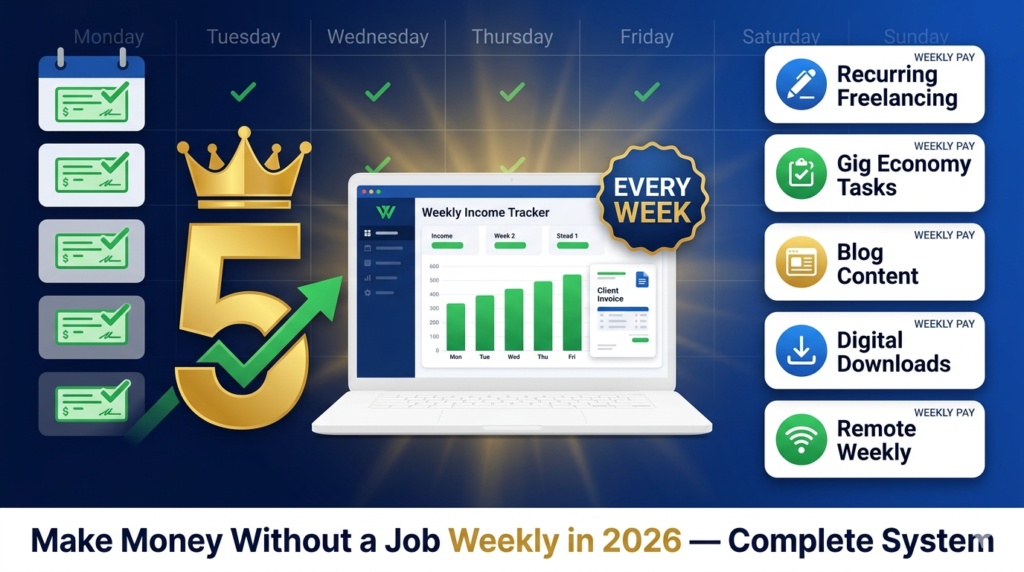
How to make money without a job weekly in 2026 is a more specific and more practical question than the general make money online question — because weekly income solves a specific problem that monthly income does not: the cash flow gap between monthly payment cycles and weekly expense obligations.
Most people who need income without a job need it weekly — rent contributions, grocery costs, transportation, utility bills, and daily living expenses do not wait for monthly payment schedules. The income methods that pay monthly are genuinely valuable for long-term financial planning. The income methods that pay weekly are genuinely essential for people managing real-world weekly expense cycles without employment income.
This guide covers every legitimate method for making money without a job weekly in 2026 — identifying which methods pay weekly or faster, which platforms have weekly payment schedules, and how to build a system that produces reliable weekly income rather than unpredictable monthly lump sums that create cash flow gaps between payment periods.
2. How to Make Money Without a Job Weekly — The Honest Reality
How to make money without a job weekly in 2026 requires understanding the structural difference between methods that pay on completion — which can produce weekly income from day one — and methods that pay on accumulation — which require weeks or months of traffic, audience, or commission accumulation before the first payment threshold is reached.
The honest reality is that weekly income and passive income are frequently incompatible in the early stages of building income without a job. The methods that produce genuinely passive income — blogging, affiliate marketing, digital products — pay on accumulation timelines that are measured in months rather than weeks during the foundation phase. The methods that produce weekly income — freelancing, gig economy work, direct service offering — require active effort each week to produce payment each week.
The strategic solution is sequencing rather than choosing. Use weekly-payment methods to cover immediate weekly expenses. Simultaneously build accumulation-payment methods in the background. As accumulation-payment income grows, the dependency on weekly-payment active methods decreases — until passive income covers weekly expenses without requiring weekly active effort to generate it.
3. Why Most People Fail to Build Reliable Weekly Income Without a Job
The failure rate among people attempting to make money without a job weekly follows patterns specific to the weekly income context.
Pursuing monthly-payment methods when weekly income is needed is the first failure pattern. Blogging, affiliate marketing, and digital products are excellent long-term income strategies — and genuinely wrong solutions for someone who needs income this week. Matching the income method to the income timeline need is the most important strategic decision in the weekly income context.
Treating each week as independent rather than building systems is the second failure pattern. Weekly income that requires starting from scratch each week — finding new clients, identifying new gig opportunities, selling new items — is exhausting and inconsistent. The correct approach is building repeating weekly income systems — recurring clients, regular gig platform activity, ongoing content that generates weekly affiliate clicks — that produce weekly income without weekly reinvention.
Underestimating the compounding potential of weekly income activity is the third failure pattern. A freelancer who earns two hundred dollars per week from consistent outreach is not just earning two hundred dollars — they are building client relationships, testimonials, and a reputation that compounds into higher weekly income over time. Each week of consistent activity produces more than the week’s income — it produces the foundation for next week’s higher income.
4. Positive and Negative — What Making Money Without a Job Weekly Actually Looks Like
Real positive example: A twenty-eight year old in Sweden built a weekly income system over four months that produced reliable income every single week without exception. Monday through Wednesday she completed client work for two recurring social media management clients paying a combined total of six hundred euros per month — invoiced and paid within the same week. Thursday she sent ten new outreach messages to prospects. Friday she published one blog post with affiliate links — accumulation income building in the background. By month four her weekly system was generating one hundred and fifty euros per week from recurring clients plus thirty to fifty euros per week from growing affiliate commissions. The system ran on twenty hours per week and paid every Friday.
Real negative example: A thirty-two year old in the United Kingdom needed weekly income after losing his job and spent four months building a blog and affiliate marketing strategy — methods he had read were the most scalable online income approaches. After four months he had zero weekly income from the blog — which was accurate given the three to six month timeline before blog income appears — and had depleted his savings covering weekly expenses that the blog could not yet cover. The method was correct for long-term income. It was categorically wrong for weekly income need. The correct approach was freelancing for immediate weekly income while building the blog in parallel.
5. The Weekly Payment Methods — What Actually Pays Weekly
6. How to Make Money Without a Job Weekly — Methods That Pay on Completion
Direct service freelancing pays on project completion — typically within three to seven days of invoice submission for direct outreach clients and within one to five business days for platform clients using payment protection. A freelancer who completes a project on Monday and invoices immediately can receive payment by Thursday of the same week.
Gig economy platforms pay on task completion — TaskRabbit processes payment within twenty-four hours of task completion confirmation, Wonolo pays at the end of each shift, and most physical gig platforms offer weekly or faster payment cycles specifically because gig workers depend on rapid payment.
Local service offering pays on service delivery — lawn care, cleaning, dog walking, and errand running generate cash in hand the same day the service is performed. No payment processing delays. No platform payment schedules. Immediate cash receipt.
Selling items online pays within one to three days of buyer confirmation on most platforms — Facebook Marketplace generates cash on collection, eBay releases payment within one to three days of delivery confirmation, and Depop releases payment immediately upon buyer confirmation.
7. How to Make Money Without a Job Weekly — Methods That Pay on Accumulation
Blogging and affiliate marketing pay when accumulated traffic generates enough clicks and conversions to reach payment thresholds — typically monthly, not weekly, and only after three to six months of content accumulation.
Digital products pay on sale — which can happen the same week as launch if promotion reaches the right audience, or weeks and months later if audience building is required first.
YouTube and social media monetization pays monthly through platform payment schedules, typically on a thirty to sixty day delay from earnings accumulation.
Understanding this distinction — completion payment versus accumulation payment — is the foundational knowledge that prevents the most common weekly income mistake: pursuing accumulation methods when completion methods are needed.
8. The Best Methods for Making Money Without a Job Weekly in 2026
9. Method One — Recurring Freelancing Clients
Recurring freelancing clients are the most reliable system for making money without a job weekly in 2026 — because a client paying a fixed monthly retainer generates predictable weekly income that does not require weekly reinvention.
A social media management client paying four hundred dollars per month generates one hundred dollars per week of recurring income — from work that was sold once, structured once, and now generates payment reliably without new client acquisition effort each week. Two such clients generate two hundred dollars per week. Five generate five hundred dollars per week.
The path from zero to recurring clients follows a specific sequence. First clients are acquired through daily outreach. First clients are converted from one-time projects to recurring retainers by proposing ongoing packages at the completion of the first project. Recurring clients are retained through consistent delivery quality and proactive communication. Each retained client reduces the outreach required to maintain weekly income — until the recurring client base covers weekly expenses without additional client acquisition.
Realistic weekly income from recurring freelancing:
- Week 1-4: $0 building first clients through outreach
- Week 5-8: $50-$150 per week from first recurring clients
- Week 9-16: $150-$400 per week as client base grows
- Month 6+: $400-$1,500 per week from established recurring clients
According to Upwork’s Resource Center, freelancers with established recurring client relationships earn significantly more per hour than freelancers working exclusively on one-time projects — confirming that recurring client conversion is both an income stability strategy and an income growth strategy simultaneously.
For the complete system for landing and converting freelance clients to recurring relationships, read: How to Land Your First Freelance Client With Zero Experience in 2026
10. Method Two — Weekly Gig Economy Participation
Gig economy platforms with weekly payment schedules represent the most immediately accessible source of weekly income without a job — because task availability, same-day payment, and no minimum income threshold before payment is released make them the fastest path from zero to weekly income for people without existing skills or client relationships.
TaskRabbit, Wonolo, Gigwalk, and similar platforms all offer weekly or faster payment cycles. A person who accepts three to five tasks per week on TaskRabbit at fifteen to forty-five dollars per task generates forty-five to two hundred and twenty-five dollars of weekly income — paid within twenty-four hours of each task’s completion confirmation.
The weekly gig income system that produces the most consistent results combines platform-based gig acceptance with local service promotion — using the platform for discoverability and the local service offering for immediate cash without platform fees. Platform income arrives weekly through automatic payment. Local service income arrives the same day in cash.
Realistic weekly income from gig economy participation:
- Week 1: $50-$150 from first task acceptances
- Week 2-4: $100-$300 per week with consistent participation
- Month 2+: $200-$500 per week with established platform presence
According to Statista’s Gig Economy Report, gig economy workers who participate consistently — accepting tasks at least four days per week — earn significantly more per month than inconsistent participants, confirming that weekly gig income is a system that rewards consistency rather than occasional participation.
For methods that generate income starting tonight, read: How to Make Money Without a Job Overnight in 2026
11. Method Three — Content Creation With Weekly Monetization
Content creation platforms that pay weekly or on-demand provide the compounding income structure of content creation with payment schedules more aligned with weekly income needs than traditional monthly blogging income.
Medium’s Partner Program pays monthly — but Medium earnings accumulate quickly enough that monthly payments represent meaningful weekly income equivalents once readership is established. YouTube’s payment schedule is monthly, but merchandise shelf, Super Chat, and channel membership income can be structured for more frequent access. Patreon allows creators to set monthly billing that produces consistent monthly income — which, divided across weeks, represents predictable weekly income for established creators.
The content creation approach that produces the fastest weekly income combines platform publishing with affiliate link promotion — where platform payments arrive monthly and affiliate commissions from links in content arrive as clicks convert to purchases, creating a more continuous income stream than platform payments alone.
Realistic weekly income from content creation:
- Month 1-3: $0 building audience
- Month 4-6: $10-$50 per week from first platform payments
- Month 6-12: $50-$300 per week as audience compounds
According to Backlinko’s Content Research, content creators who publish consistently — at least one piece per week — build audience significantly faster than irregular publishers, confirming that weekly publishing is both an income growth strategy and an audience compounding strategy.
For the complete system for writing blog content that builds weekly traffic, read: How to Write Blog Posts That Rank on Google Page 1 in 2026
12. Method Four — Digital Products With Weekly Promotion
Digital products generate income when they are purchased — which can happen any day of any week once the product is listed and promoted. The weekly promotion system converts a digital product from an occasional income source to a weekly income generator.
The weekly digital product promotion system works as follows. Monday: share the product in one new relevant online community. Wednesday: publish one piece of free content related to the product’s topic — a social media post, a Medium article, a Pinterest pin — with a natural mention of the product as the next step for interested readers. Friday: send one email to existing list subscribers highlighting the product’s specific benefit.
This three-touch weekly promotion cycle — community share, content mention, email highlight — generates consistent weekly product discovery that translates to consistent weekly purchases without requiring new product creation each week.
Realistic weekly income from consistent digital product promotion:
- Week 1-4: $0-$50 from initial launch and first promotion
- Week 5-8: $20-$100 per week with consistent promotion
- Month 3+: $100-$500 per week as audience and reviews compound
According to Gumroad’s Creator Blog, digital product creators who promote consistently — at least three promotional touchpoints per week — generate significantly more monthly income than creators who publish and wait without active weekly promotion.
For the complete system for creating and promoting digital products for weekly income, read: How to Create and Sell a Digital Product Online in 2026
13. Method Five — Remote Work With Weekly Payment Options
Remote work platforms and employers increasingly offer weekly payment options in 2026 — recognizing that remote workers, particularly those replacing traditional employment income, need payment schedules that match their expense cycles rather than corporate quarterly payment systems.
Platforms including Deel, Remote.com, and several direct remote employers offer weekly payment options for contractors. Customer support roles, virtual assistance positions, and content moderation work are all consistently available with weekly payment options from employers who have specifically designed their payment infrastructure to accommodate remote workers’ cash flow needs.
For the complete list of remote platforms and employers offering weekly payment options, read: Best Remote Job Platforms in 2026: Where to Apply and How to Get Hired Fast
14. The Real Challenges of Making Money Without a Job Weekly
15. Challenge One — Weekly Income Inconsistency Before Systems Are Built
The most significant challenge for people making money without a job weekly in 2026 is the inconsistency of weekly income before recurring client relationships, established gig platform presence, and consistent digital product promotion systems are in place.
Week one might generate two hundred dollars. Week two might generate fifty dollars. Week three might generate three hundred dollars. This inconsistency is normal in the early stages — and it is the inconsistency that causes most people to conclude the system is not working, precisely when it is working exactly as expected.
The honest fix: Track weekly income over four-week rolling averages rather than individual weeks. A four-week average that is increasing is a working system regardless of individual week variation. A four-week average that is stagnant or declining is a signal for strategic adjustment. Individual week variation is noise. Four-week trend is signal.
Real positive example: A freelancer in Ireland tracked her weekly income over her first twelve weeks. Week one: zero. Week two: one hundred and sixty euros. Week three: zero. Week four: two hundred and forty euros. Week five: eighty euros. Week six: three hundred and twenty euros. Individual weeks looked inconsistent. Four-week rolling averages showed consistent growth: forty euros, one hundred and twenty euros, two hundred and ten euros. The system was working. Individual week variation was concealing the trend.
16. Challenge Two — The Feast and Famine Weekly Income Cycle
Freelancers and gig workers without recurring income systems frequently experience feast and famine weekly income cycles — weeks with abundant work and weeks with none, driven by client project timing, gig platform task availability, and the uneven distribution of market demand across calendar weeks.
The honest fix: Build two income layers simultaneously. Layer one: active completion-payment methods that generate weekly income when effort is applied. Layer two: passive accumulation-payment methods that generate income regardless of effort in any given week. Layer two income smooths the feast and famine pattern of layer one by providing baseline weekly income that exists whether or not active work is completed that week.
17. Challenge Three — Underpricing Weekly Services
People building weekly income without a job frequently underprice their services because they are thinking about weekly totals rather than hourly rates — accepting low-rate work that fills the week with activity but generates inadequate weekly income relative to hours invested.
The honest fix: Calculate every income opportunity as an hourly rate before accepting it. A project paying one hundred dollars that takes ten hours produces ten dollars per hour — below minimum wage in most markets and significantly below what the same skill commands when positioned correctly. Raise rates progressively. Each rate increase that retains clients confirms the rate is supported by the value delivered.
18. The Weekly Income Building Roadmap
19. Week One — First Weekly Income System Setup
Week one establishes the foundation for consistent weekly income — not income itself, but the infrastructure that income will flow through. Set up a Payoneer or Stripe account for receiving client payments. Create a simple invoice template. Register on two gig economy platforms. Send ten direct outreach messages to potential freelancing clients.
20. Week Two — First Weekly Income Attempt
Week two produces the first market-facing income activity — first gig task accepted, first client proposal sent, first digital product listed. The goal is not significant income. The goal is first market contact that reveals what adjustments are needed for week three.
21. Week Three and Four — First Weekly Income
Weeks three and four produce the first actual weekly income for most consistent practitioners — a first gig payment, a first client invoice paid, a first digital product sale. The amount is less important than the evidence that the weekly income system produces real results from real market activity.
22. Month Two — First Recurring Weekly Income
Month two introduces the first recurring weekly income element — converting a first-time client to a recurring retainer, establishing a consistent gig platform presence with predictable weekly task availability, or building a digital product promotion habit that generates consistent weekly sales.
23. Month Three — Weekly Income Stabilization
Month three is where weekly income stabilizes — not perfectly consistent week to week, but consistently above a minimum threshold that covers basic weekly expenses. For most practitioners following this roadmap, month three weekly income ranges from one hundred to four hundred dollars per week.
24. Common Mistakes When Building Weekly Income Without a Job
25. What Prevents Consistent Weekly Income From Arriving
Not converting one-time clients to recurring relationships is the most significant weekly income mistake for freelancers. Every one-time project is an opportunity to propose a recurring arrangement — and recurring arrangements are what transforms inconsistent weekly income into reliable weekly income.
Treating gig work as temporary rather than as a system prevents the platform experience accumulation that produces higher task availability and higher hourly rates over time. Gig platforms reward consistent participants with better algorithm visibility — treating gig work as an emergency measure rather than a system means never accumulating the platform credibility that makes gig income more reliable.
Building only active income without accumulation income in parallel creates permanent dependency on weekly active effort for weekly income. The goal is not weekly active income indefinitely — it is weekly income that requires decreasing active effort over time as accumulation income grows. Both must be built simultaneously for the system to achieve its ultimate goal.
26. Trusted External Resources
For freelancing platform payment schedules and weekly payment options across the major platforms operating in 2026, Upwork’s Resource Center provides current documentation on payment timing, withdrawal options, and weekly payment availability for different contract types.
For gig economy platform payment schedules including which platforms offer same-day or weekly payment and which task categories produce the most consistent weekly income, Statista’s Gig Economy Data provides current market research on gig worker income patterns and payment structures.
For digital product promotion strategies that generate consistent weekly sales rather than launch-spike-and-decline patterns, Gumroad’s Creator Resources cover the complete weekly promotion system for established digital product creators.
For understanding how consistent weekly content publication builds compounding organic traffic that generates accumulation income alongside active weekly income, Google Search Central provides the definitive guidance on how regular content publication affects search ranking and traffic growth.
For the complete guide covering every method for making money without a job in 2026 beyond the weekly-specific approaches in this guide, read: How to Make Money Without a Job in 2026: The Complete Beginner’s Guide
27. Real Questions About Making Money Without a Job Weekly
Which income method produces the most reliable weekly income without a job?
Recurring freelancing retainers produce the most reliable weekly income of any method — because the income is contracted in advance, the work scope is defined in advance, and the payment schedule is agreed in advance. A freelancer with three recurring retainer clients paying combined monthly fees has converted irregular project income into salary-equivalent reliability. The path to recurring retainers is consistent delivery quality on first projects combined with proactive retainer proposals at project completion.
How much weekly income is realistic in the first month without a job?
In the first month, weekly income from active methods — gig economy work, local services, item selling — ranges from fifty to three hundred dollars per week depending on hours invested, skills available, and market access. Weekly income from freelancing typically begins in weeks three to five for practitioners who send consistent daily outreach. The first month is the most variable — consistent practitioners see weekly income stabilize significantly in months two and three.
Can you build genuinely passive weekly income without a job?
Genuinely passive weekly income — income that arrives each week without active effort in that week — requires three to six months of foundation building before it appears. Blog traffic, affiliate commissions, and digital product sales all become increasingly passive over time as the content, audience, and reputation that generates them compounds. The path to passive weekly income runs through active weekly income — using active methods to cover expenses while passive methods compound in the background.
What is the fastest way to generate weekly income starting from zero?
Local service offering — lawn care, cleaning, dog walking, errand running — produces cash-in-hand income the same day services are performed, from week one of beginning. No platform registration, no payment processing delays, no minimum thresholds. Flyers distributed on a Saturday morning can generate income by Saturday afternoon. The income ceiling is lower than most online methods but the weekly income timeline is faster than any alternative.
How do you stabilize weekly income when client work is inconsistent?
Build two parallel income systems — a recurring client base that provides baseline weekly income and an active outreach system that fills gaps. When recurring clients provide enough weekly income to cover basic expenses, the active outreach system generates additional income rather than survival income. The psychological shift from survival outreach to growth outreach produces higher-quality proposals, better client targeting, and ultimately higher-quality recurring clients — compounding the weekly income stabilization over time.
28. Final Words — Weekly Income Is a System, Not a Payment Schedule
How to make money without a job weekly in 2026 has one foundational answer: weekly income is not a payment schedule — it is a system. The payment schedule is the output. The system is the recurring client relationships, consistent gig platform participation, weekly digital product promotion, and parallel accumulation income building that produces reliable weekly output.
The person who builds recurring client relationships is not building weekly income — they are building a system that produces weekly income as a natural output. The person who participates consistently in gig platforms is not generating individual weekly payments — they are building platform credibility that makes each week’s income more reliable than the last.
Systems compound. Payment schedules do not. The goal is not weekly income this week — it is a system that produces weekly income every week, with decreasing active effort required as accumulation income fills the gaps that active methods leave.
Build the system. The weekly income follows.
For the complete picture of every online income method available in 2026, read: How to Make Money Online in 2026: The Complete Beginner’s Guide