
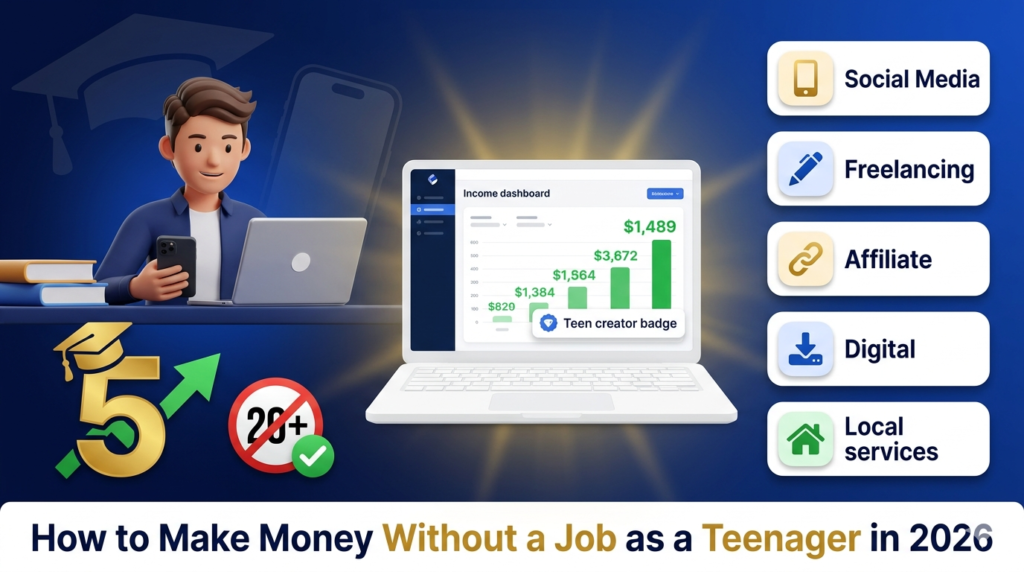
How to make money without a job as a teenager in 2026 is the question that most income guides answer with advice designed for adults — ignoring the specific legal restrictions, platform age requirements, payment method limitations, and parental consent considerations that make standard income advice genuinely inaccessible to people under eighteen.
This guide is different. Every method covered here has been specifically evaluated for teenage accessibility — confirming age eligibility requirements, identifying payment methods available without adult bank accounts, and acknowledging the parental involvement that some methods require without treating that involvement as a barrier rather than a manageable step.
Being a teenager in 2026 is not an obstacle to building real income. For the specific methods covered in this guide, it is sometimes an advantage — because teenagers possess platforms, audiences, and content creation instincts that adults consistently underestimate and occasionally fail to replicate.
2. How to Make Money Without a Job as a Teenager — The Honest Reality
How to make money without a job as a teenager in 2026 is genuinely possible — and the teenager-specific constraints, once understood and navigated, are significantly less limiting than most guides imply.
The honest reality is that the legal and platform constraints affecting teenage income are real but narrow. Most income-generating platforms have no age restriction. Most payment methods are accessible at sixteen with minimal documentation. Most clients and buyers purchasing from online creators do not know or care about the age of the creator — they care about the quality of the content, the usefulness of the product, or the reliability of the service.
The teenager-specific advantage that most guides miss entirely is the authenticity premium. A sixteen-year-old creating content about being sixteen — the academic pressures, the social dynamics, the financial constraints, the technology habits — possesses first-hand knowledge that no adult can authentically replicate. That authenticity is commercially valuable in the content economy of 2026 in ways that were not available to previous generations of teenagers.
3. Why Most Teenagers Fail to Make Money Without a Job
The failure rate among teenagers attempting to make money without a job follows patterns specific to the teenage context.
Attempting age-restricted methods without verifying eligibility is the first failure pattern. Teenagers who invest weeks building strategies around platforms requiring users to be eighteen — certain affiliate networks, some freelancing platforms, most traditional banking-linked payment systems — discover the limitation only at the point of attempting to receive payment. This guide identifies age eligibility for every method covered before describing the method itself.
Underestimating parental support as an asset is the second failure pattern. Many teenagers treat parental involvement in income-building as a limitation to work around rather than a resource to leverage. A parent who co-signs a bank account, provides a PayPal account for payment receipt, or simply confirms legitimacy of a platform before their teenager invests time in it is providing genuine value — not creating obstruction. Teenagers who approach parents as collaborators in income-building consistently progress faster than those who treat parental awareness as a risk to manage.
Choosing entertainment over income-building is the third failure pattern specific to teenagers. The same smartphone that can generate income through content creation and gig economy participation is used for an average of seven hours per day for entertainment purposes by teenagers in 2026. Redirecting thirty to sixty minutes of that daily entertainment time toward income-generating activity requires no additional time investment — only a deliberate reallocation of existing phone time.
4. Positive and Negative — What Making Money Without a Job as a Teenager Actually Looks Like
Real positive example: A fifteen-year-old in the United Kingdom began posting short-form study tip videos on TikTok during her GCSE preparation year — genuine advice from someone actively experiencing the process rather than retrospectively describing it. By month four she had sixty-eight thousand followers, two brand partnership inquiries from revision tool companies, and affiliate commission income of two hundred and forty pounds per month from links in her video descriptions. Her parents helped set up a bank account for payment receipt. Total investment: zero. The content came from her genuine daily experience.
Real negative example: A sixteen-year-old in the United States spent three weeks building a detailed affiliate marketing website, selecting products, writing review content, and setting up tracking links — only to discover at the application stage that the affiliate network required applicants to be eighteen. The three weeks of work were not entirely wasted — the content existed and could be repurposed for platforms without age restrictions — but the timeline setback and discouragement produced by this entirely avoidable discovery caused him to abandon the project entirely rather than pivot to accessible alternatives.
5. Age Eligibility — What Teenagers Can Actually Access in 2026
6. Platforms Accessible at 13+
Social media platforms including TikTok, YouTube, and Instagram are accessible from age thirteen in most markets with parental consent. These platforms offer creator monetization programs that have varying minimum age requirements — typically sixteen to eighteen for direct payment — but allow content creation and audience building from age thirteen, meaning teenagers can begin building the audience that monetizes later before reaching monetization eligibility.
Pinterest has no minimum age requirement for content creation and affiliate link inclusion, making it accessible for affiliate marketing promotion from any age with parental awareness. Content published on Pinterest with affiliate links in descriptions generates commissions regardless of creator age because the purchase decision is made by the viewer, not the creator.
7. Platforms Accessible at 16+
The majority of legitimate income-generating platforms are accessible from age sixteen. Amazon Associates accepts applicants from sixteen in most markets. ClickBank and Digistore24 have no formal age restriction beyond requiring a valid payment method. Gumroad requires a Stripe or PayPal account for payment receipt — both accessible to sixteen-year-olds with parental co-signing in most markets.
Upwork and Fiverr technically require users to be eighteen but do not verify age through identity documentation at registration — meaning sixteen and seventeen-year-olds create accounts regularly. This guide does not recommend misrepresenting age on these platforms — but notes that the practical barrier is payment method rather than platform registration for teenagers in this age range.
8. Payment Methods for Teenagers
With parental involvement (any age):
Payment received through a parent’s PayPal account or bank account with transparent income tracking is the most broadly accessible payment method for teenagers of any age.
At sixteen (most markets):
A student bank account or basic checking account accessible at sixteen with or without parental co-signing depending on the market. PayPal accessible at sixteen with valid bank account. Stripe accessible at sixteen with valid bank account.
At eighteen:
All payment methods become fully accessible without parental involvement. Teenagers approaching eighteen who are building income in the sixteen to seventeen period should set up their own payment infrastructure at eighteen as the first action of that milestone.
9. The Best Methods for Making Money Without a Job as a Teenager in 2026
10. Method One — Social Media Content Creation
Social media content creation is the most teenager-native income method available in 2026 — because the platforms that pay creators were designed for exactly the demographic that teenagers represent, and the content that performs best on these platforms is frequently created by people with first-hand experience of being a teenager.
TikTok, YouTube Shorts, and Instagram Reels are all accessible from thirteen with parental consent and offer creator monetization programs accessible from sixteen. A teenager who begins building an audience at fourteen reaches monetization eligibility at sixteen with two years of audience compounding behind them.
The teenager-specific content advantage:
Content about student life, exam preparation, teenage financial management, part-time income, gaming, fashion, technology, and social dynamics all attract large audiences of peers and younger teenagers — audiences that adult creators cannot authentically reach and that brands consistently pay to access.
Realistic income for teenage social media creators:
- Month 1-3: $0 building audience
- Month 4-6: $20-$150 per month from first monetization
- Month 6-12: $150-$1,000 per month as audience grows
- Year 2+: $1,000-$10,000+ per month for established creators
According to Statista’s Creator Economy Report, creator economy revenue exceeded one hundred billion dollars globally in 2025 — with teenage creators in specific niches generating disproportionate engagement rates that attract brand partnership budgets significantly above their follower count would suggest.
11. Method Two — Freelancing for Teenagers
Freelancing is accessible to teenagers making money without a job as a teenager in 2026 through channels that do not require platform age verification — primarily direct outreach to local businesses and individuals who hire based on capability rather than age.
Local businesses, family connections, school community networks, and neighborhood outreach all represent client acquisition channels where age is irrelevant to the hiring decision. A fifteen-year-old who creates genuinely professional social media graphics for a local restaurant is evaluated based on the quality of the graphics — not their date of birth.
Teenager-accessible freelancing skills:
Social media content creation, basic graphic design using Canva, video editing for short-form content, social media account management, basic website content writing, and photography for small businesses — all of these are learnable at teenager age and hireable through channels that do not require age verification.
Realistic income for teenage freelancers:
- Month 1-2: $0-$100 building samples and landing first local clients
- Month 3-6: $100-$500 per month with regular local clients
- Month 6-12: $300-$1,500 per month through expanding client base
According to Upwork’s Resource Center, the freelancing skills with lowest barriers to entry — social media management, basic content writing, and simple graphic design — are also the skills with the highest demand growth in 2026, creating genuine market opportunity for teenage practitioners with developing but genuine competence.
For the complete system for landing freelance clients through direct outreach without platform age restrictions, read: How to Land Your First Freelance Client With Zero Experience in 2026
12. Method Three — Affiliate Marketing for Teenagers
Affiliate marketing is accessible to teenagers making money without a job as a teenager through platforms with no age restriction — Pinterest, personal blogs, and social media bio links — combined with affiliate programs accessible from sixteen.
The teenage affiliate marketing approach that works best in 2026 combines TikTok or YouTube content with affiliate links in bios and descriptions — promoting products genuinely used and recommended to audiences of peers who trust the recommendation because it comes from someone with identical circumstances and identical experience.
Teenager-accessible affiliate programs:
Amazon Associates (16+), ClickBank (no formal age restriction), Digistore24 (no formal age restriction), and Systeme.io (no formal age restriction) — all of these provide genuine affiliate income opportunities accessible to teenagers with valid payment methods.
Realistic affiliate income for teenagers:
- Month 1-3: $0 building content and audience
- Month 4-6: $10-$100 per month from first clicks
- Month 6-12: $100-$800 per month as audience grows
According to Authority Hacker, affiliate marketing through social media platforms — the primary teenager-accessible channel — is growing faster than blog-based affiliate marketing in 2026, confirming that the teenager-native content creation approach is aligned with the direction the affiliate marketing industry is moving.
For the complete framework for choosing affiliate products that convert for teenager audiences, read: Affiliate Marketing for Beginners: How to Choose Products That Actually Convert in 2026
13. Method Four — Selling Digital Products as a Teenager
Digital products represent one of the most accessible income methods for teenagers making money without a job as a teenager — because they can be created from knowledge teenagers already possess, sold through platforms accessible from sixteen, and delivered automatically without ongoing involvement.
Study guides, revision resources, exam preparation templates, student budget trackers, and subject-specific cheat sheets are all digital products that teenagers create from current, tested knowledge and sell to audiences of peers facing identical challenges.
The teenage digital product advantage is the annually-renewing market. New students face GCSE exams every year, new university applicants navigate application processes every year, new freshers experience first-year university every year. A study guide created in 2026 sells to the 2027 cohort and the 2028 cohort without any additional work from the creator.
Realistic digital product income for teenagers:
- Month 1-2: $0 creating and listing
- Month 3-4: $20-$200 per month from first sales
- Month 6-12: $200-$1,500 per month with growing audience
According to Gumroad’s Creator Blog, study resources and academic templates are among the fastest-growing digital product categories on the platform — confirming genuine market demand for the knowledge that teenagers specifically possess.
For the complete system for creating and selling digital products from existing knowledge, read: How to Create and Sell a Digital Product Online in 2026
14. Method Five — Local Services for Teenagers
Local services represent the most immediately accessible income method for teenagers making money without a job as a teenager — requiring no platform, no age verification, no payment infrastructure, and no digital skills. Cash in hand from a neighbor for lawn care is as legitimate and as valuable as a PayPal transfer from a freelancing client.
Lawn care, car washing, dog walking, grocery shopping, house sitting, tutoring younger students, and technology assistance for elderly neighbors — all of these are genuine services with genuine local demand and genuine cash payment from the same day they are offered.
Realistic income from teenage local services:
- Day 1: Offer services to ten local households
- Day 2-3: First clients and first cash
- Week 1: $50-$200 depending on services and availability
- Month 1: $100-$500 with consistent regular clients
For the complete guide covering every income method available without a job in 2026, read: How to Make Money Without a Job in 2026: The Complete Beginner’s Guide
15. The Real Challenges of Making Money Without a Job as a Teenager
16. Challenge One — Legal Employment Age Restrictions
Most formal employment has minimum age requirements — typically sixteen in the United Kingdom and fourteen in the United States for limited categories of work. These restrictions apply to employment — they do not apply to self-employment, freelancing, content creation, or digital product sales, all of which are accessible at any age.
The honest fix: Focus exclusively on self-employment income methods rather than seeking formal employment. The income methods in this guide are all self-employment activities that exist outside formal employment law age restrictions.
Real positive example: A fourteen-year-old in Sweden who could not legally work in any formal employment capacity began creating Canva template packs for student organizers and selling them on Etsy with her parent’s account. By month five she was earning three hundred kronor per month from ongoing template sales without ever needing formal employment eligibility.
17. Challenge Two — School Schedule Constraints
School schedules create similar constraints to academic schedules for university students — but with less flexibility, less control, and less tolerance for schedule deviation than the adult educational environment.
The honest fix: Treat income activity as exclusively asynchronous. Every income method pursued as a teenager must be completable outside of school hours, on weekends, and during holidays — without ever conflicting with the academic performance that protects future opportunities. Income that costs grades is not worth pursuing.
18. Challenge Three — Parental Awareness and Consent
Many income methods require parental awareness or active involvement — payment account access, platform registration consent, or simply the knowledge that their teenager is spending significant time on income-building activities. Teenagers who pursue income without parental awareness risk losing access to the activities if discovered, and miss the genuine support that informed parents can provide.
The honest fix: Present the income plan to parents before beginning. Show the specific platform, the specific method, the payment mechanism, and the time commitment. Most parents who understand the plan support it — particularly when it replaces entertainment time rather than competing with academic time.
19. The 6-Month Roadmap for Teenagers Making Money Without a Job
20. Month One — Platform Setup and First Content
Month one is platform setup, parental conversation, and first content creation or first portfolio sample. No income expected. No income pressure. The goal of month one is establishing the infrastructure and creating the first output that the market can evaluate.
21. Month Two — First Market Contact
Month two introduces the first market interaction — posting the first content publicly, sending the first outreach message to a local business, listing the first digital product, or offering the first local service. The market response reveals whether the approach is resonating — not whether the income goal is achievable.
22. Month Three — First Evidence
Month three produces the first concrete evidence of traction — a first follower growth spike, a first affiliate click, a first product sale, a first local service client. The amount is less important than the evidence that the system produces real responses from real people.
23. Month Four and Five — Building Consistency
Months four and five are where the income activity becomes genuinely habitual — thirty to sixty minutes per day of consistent output that compounds regardless of whether any individual day feels productive.
24. Month Six — First Real Income
Month six produces the first monthly income figure worth describing as income rather than pocket money — somewhere between fifty and five hundred dollars depending on the method, the consistency, and the market.
That figure, however modest, represents something more important than the money itself — proof that a teenager with a phone, a skill, and thirty minutes per day can generate real income without a job, without formal employment eligibility, and without waiting for adulthood.
25. Common Mistakes Teenagers Make When Trying to Make Money Without a Job
26. What Prevents Results From Arriving for Teenagers
Pursuing age-restricted methods without checking eligibility wastes the most time and produces the most discouragement. Every method in this guide has been evaluated for teenage accessibility. Methods outside this guide should be evaluated for age eligibility before any time is invested.
Treating income as a secret from parents creates unnecessary risk and misses genuine support. The methods in this guide are legitimate, legal, and appropriate for teenagers — they do not need to be hidden.
Stopping when school gets difficult interrupts compounding at exactly the moment it is beginning to produce results. Reduce output volume during exam periods — do not eliminate it. One post per week is infinitely more productive than zero posts per week during exams.
27. Trusted External Resources
For understanding creator monetization age requirements across every major social media platform in 2026, Statista’s Creator Economy Data provides current information on eligibility requirements, payment structures, and audience demographics by platform.
For affiliate programs accessible to teenage creators without adult identity verification requirements, Digistore24’s Affiliate Program provides one of the most accessible entry points for teenage affiliate marketers in 2026.
For digital product creation tools with no age restriction and professional output quality, Canva’s Education Platform provides the complete toolkit for teenage digital product creators regardless of design background.
For understanding how Google evaluates content — foundational for teenagers building blogs or YouTube channels as long-term income assets, Google Search Central is the definitive primary source.
For the broader context of every income method available without a job in 2026, read: How to Make Money Without a Job in 2026: The Complete Beginner’s Guide
28. Real Questions From Teenagers
Can you actually build income as a teenager without a job in 2026?
Yes — and the teenager-specific constraints narrow the available methods without eliminating the opportunity. Social media content creation, local services, affiliate marketing through accessible platforms, and digital products from academic knowledge are all genuinely accessible to teenagers at various age thresholds. The income timeline is longer than for adults with full-time availability, but the compounding that begins during teenage years produces significantly more advanced income positions by adulthood than starting from scratch at eighteen.
What is the best income method for a thirteen or fourteen year old?
Local services and social media content creation represent the most accessible methods at thirteen and fourteen — both require no platform age verification beyond parental consent and both generate real income from existing skills and existing circumstances. A fourteen-year-old offering lawn care to ten neighbors generates cash income this week. A fourteen-year-old posting genuine content about their daily life begins building an audience that monetizes at sixteen.
How do you receive payment as a teenager?
Through a parent’s PayPal or bank account at any age with transparent income tracking. Through a student bank account accessible at sixteen in most markets. Through cash payment for local services at any age. The payment method question is the most frequently cited barrier to teenage income — and it is one of the easiest to resolve with minimal parental involvement.
Do you need to tell your parents?
Practically and ethically, yes. The income methods in this guide require either payment infrastructure that involves parents or significant time investment that parents will notice. Approaching parents with a specific, legitimate plan — this platform, this method, this payment mechanism, this time commitment — consistently produces support rather than opposition.
How much can a teenager realistically earn without a job?
Between fifty and five hundred dollars per month by month six for teenagers who commit thirty to sixty minutes per day to one consistent income method. This range reflects the combination of available hours, platform limitations, and audience-building timelines specific to the teenage context. Teenagers with more available time — particularly during summer breaks and school holidays — consistently reach the higher end of this range.
29. Final Words — Start Now, Not at Eighteen
How to make money without a job as a teenager in 2026 has one foundational answer: the constraints of being a teenager narrow the available methods without eliminating the opportunity — and the teenager who begins building income at fifteen arrives at eighteen in a fundamentally different position than the teenager who waits for adulthood to begin.
A TikTok account started at fifteen has three years of audience compounding by eighteen. A local service client base built at sixteen generates referrals and reviews that compound through seventeen and eighteen. A digital product library created from GCSE or A-level knowledge generates passive income through university.
The income built during teenage years does not pause for exams, school holidays, or parental conversations. It compounds quietly in the background of everything else — and arrives at adulthood as the foundation that most adults wish they had started building earlier.
Start now. Not at eighteen. Now.
For the complete picture of every online income method available in 2026, read: How to Make Money Online in 2026: The Complete Beginner’s Guide