
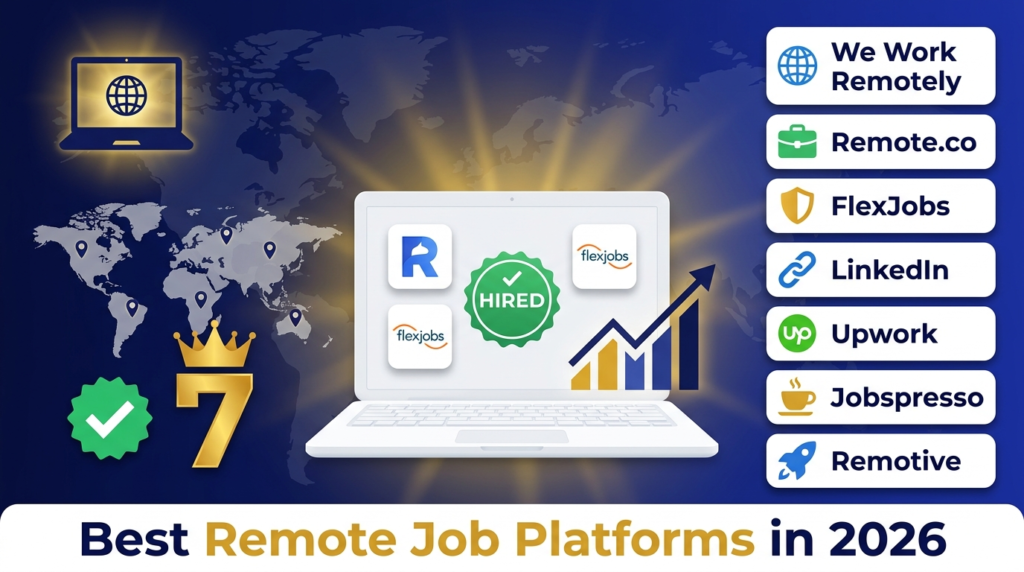
Best remote job platforms in 2026 are not equal — and choosing the wrong one as a complete beginner is the fastest way to spend weeks applying for positions that never respond, on platforms that were never designed for someone at your stage of experience or career background.
The remote work revolution has permanently changed how companies hire. In 2026, over thirty percent of all professional jobs are performed fully remotely — and the platforms connecting remote workers to those jobs range from genuinely excellent to actively misleading about the quality and volume of opportunities they list.
This guide identifies the best remote job platforms in 2026 specifically for beginners, explains exactly how to apply on each one in a way that produces responses, and gives you the honest timeline for going from your first application to your first remote paycheck — without the false promises that make most remote work guides useless in practice.
2. Why Most Beginners Fail to Get Hired on the Best Remote Job Platforms
Most beginners who fail to get hired on the best remote job platforms in 2026 make their critical mistake before they submit a single application — they apply to positions they are not qualified for, on platforms not designed for beginners, using application materials that are generic rather than specifically tailored to remote work requirements.
The remote job market in 2026 is simultaneously more accessible and more competitive than at any previous point. More accessible because geographic barriers have been eliminated — a qualified candidate anywhere in the world can apply for a position at a company anywhere in the world. More competitive because that same elimination of geographic barriers means every posted position receives applications from a global talent pool rather than a local one.
The beginners who succeed on the best remote job platforms in 2026 are not necessarily the most qualified candidates in the applicant pool. They are the candidates who understand what remote employers specifically value, present their application materials to address those specific values, and apply consistently enough on the right platforms to develop the pattern recognition that makes each subsequent application stronger than the last.
3. The Honest Challenges of Finding Remote Jobs on the Best Platforms
Challenge one: Volume without quality produces nothing. The most common beginner approach to remote job searching is applying to as many positions as possible as quickly as possible. This approach treats job applications like a lottery — the more tickets purchased, the higher the probability of winning. Remote employers receive this approach poorly. A generic application submitted to fifty positions simultaneously is identifiable within the first paragraph, and most are rejected without further consideration.
Challenge two: Platform quality varies enormously. Not all websites listing remote jobs are legitimate platforms with genuine employer relationships. Many aggregate job listings from other sources without verification, list positions that are months old, or charge fees to access contact information for opportunities that no longer exist. Choosing platforms without verifying their reputation wastes application effort on opportunities that were never real.
Challenge three: Remote-specific skills are different from general professional skills. Remote employers in 2026 consistently report that the candidates they hire are not simply the most technically skilled — they are candidates who demonstrate specific competencies that remote work requires: self-directed time management, asynchronous communication proficiency, and the ability to maintain productivity without physical supervision or real-time collaboration.
Real negative example: A marketing professional with five years of in-office experience applied to forty-seven remote marketing positions over three months using the same resume and cover letter she had used for in-office applications. She received four responses and zero job offers. After tailoring her resume to emphasize remote-relevant skills — self-directed project management, written communication, results-oriented work style — and targeting platforms specifically focused on remote marketing roles, she received responses from eleven of the next twenty applications and accepted a remote offer within six weeks.
4. The Positive Reality of the Best Remote Job Platforms in 2026
The positive reality of finding remote work through the best remote job platforms in 2026 is that the opportunity is genuinely larger than at any previous point in history — and it is accessible to candidates from virtually any country, any background, and any career stage.
Real positive example: A customer support professional in the Philippines with three years of local call center experience applied to ten remote customer support positions on We Work Remotely over thirty days. He tailored each application specifically to the company’s product and customer base, emphasized his experience handling high-volume communication efficiently, and included a brief video introduction demonstrating his English communication skills. He received responses from four companies and accepted a remote customer support role paying three times his previous local salary — working from home for a United States-based technology company.
The income differential available through remote work is particularly significant for candidates based in countries where local salaries are substantially lower than remote salaries for equivalent roles. A customer support professional earning eight hundred dollars per month locally may be fully qualified for a remote position at the same company paying two thousand five hundred dollars per month — representing more than three times the local income for identical work.
For the complete picture of how remote work fits within a broader online income strategy, read: How to Make Money Online in 2026: The Complete Beginner’s Guide
5. The 7 Best Remote Job Platforms in 2026
6. Best Remote Job Platforms in 2026 — We Work Remotely
We Work Remotely is consistently ranked among the best remote job platforms in 2026 for one straightforward reason: every position listed is genuinely remote, genuinely current, and listed by employers who have specifically chosen to hire globally rather than locally.
The platform posts between two hundred and four hundred new remote positions every week across categories including programming, design, marketing, customer support, sales, and management. Unlike general job boards that tag positions as remote without verification, We Work Remotely’s entire business model is built around serving employers who are specifically committed to remote hiring — which means the positions listed represent genuine remote opportunities rather than hybrid or flexible arrangements mislabeled for broader reach.
For beginners applying on We Work Remotely, the most important application principle is specificity. Every application should demonstrate that the candidate has researched the specific company, understands the specific role, and can articulate precisely how their specific background addresses the specific challenges that role exists to solve. Visit weworkremotely.com to browse current listings by category.
7. Best Remote Job Platforms in 2026 — Remote.co
Remote.co stands out among the best remote job platforms in 2026 for providing not just job listings but the most comprehensive educational resource available for candidates entering the remote workforce for the first time.
The platform’s job listings span over twenty professional categories and include detailed company profiles that provide context about remote culture, communication expectations, and hiring processes that most job boards omit entirely. For beginners who are uncertain whether a specific company’s remote culture aligns with their working style, Remote.co’s company profiles provide enough information to make that assessment before investing time in an application.
The platform also publishes regular interviews with remote workers across industries and career levels — providing genuine insight into what remote work actually looks like day-to-day that is more useful than any job description. Visit remote.co to access both the job listings and the educational content simultaneously.
8. Best Remote Job Platforms in 2026 — FlexJobs
FlexJobs consistently ranks among the best remote job platforms in 2026 because of one distinguishing characteristic that no free platform can match: every single listing is manually verified by the FlexJobs team before publication to confirm it is legitimate, current, and genuinely flexible or remote.
The manual verification process eliminates the scam listings, the expired positions, and the misleadingly labeled hybrid opportunities that make free job boards frustrating and time-consuming to navigate. For candidates who have wasted significant time pursuing opportunities that turned out to be illegitimate or misrepresented, the FlexJobs subscription fee — approximately fourteen dollars per month — is a straightforward trade of cost for time savings.
FlexJobs lists over fifty categories of remote and flexible work including full-time remote positions, part-time remote roles, freelance contracts, and temporary remote assignments — making it one of the most comprehensive platforms available for candidates whose remote work needs span beyond traditional full-time employment. Visit flexjobs.com to access the full listings database.
According to FlexJobs’ Annual Remote Work Report, remote job listings increased by over twenty percent in 2025 compared to the previous year — confirming that the remote work opportunity continues expanding rather than contracting despite broader economic uncertainty.
9. Best Remote Job Platforms in 2026 — LinkedIn Remote Jobs
LinkedIn’s remote job filtering has made it one of the best remote job platforms in 2026 for candidates targeting mid-level and senior positions at established companies — because LinkedIn combines the largest professional network in the world with increasingly sophisticated remote job filtering that surfaces genuinely remote opportunities across every industry.
The distinguishing advantage of LinkedIn as a remote job platform is not the job listings themselves — it is the combination of job listings with the social proof and professional network that LinkedIn provides simultaneously. A candidate whose LinkedIn profile demonstrates relevant experience, genuine recommendations from previous colleagues, and active engagement with industry content is not simply an anonymous applicant — they are a professional with a visible track record that hiring managers can investigate before the first interview.
For beginners on LinkedIn, the most important platform-specific action before applying to any position is optimizing the LinkedIn profile to include the phrase “open to remote work” in the headline, relevant remote work experience or remote-relevant skills in the experience section, and a professional headshot that communicates credibility. Visit linkedin.com/jobs and filter by “Remote” to access current listings.
10. Best Remote Job Platforms in 2026 — Upwork for Remote Work
Upwork occupies a unique position among the best remote job platforms in 2026 because it bridges the gap between freelance contracting and traditional remote employment — making it the ideal starting point for beginners who want immediate remote income while building the track record that qualifies them for traditional remote employment positions.
The structural advantage of Upwork for beginners is that the barrier to entry is lower than traditional employment platforms. Clients on Upwork are hiring for outcomes rather than resumes — a beginner who can demonstrate the ability to deliver a specific result at a reasonable rate can secure paid remote work significantly faster than through traditional job application processes.
The income ceiling on Upwork is also significantly higher than most beginners expect. Established Upwork freelancers in high-demand categories — software development, copywriting, financial consulting — earn between fifty and two hundred dollars per hour for remote work delivered entirely through the platform. Visit upwork.com to create a profile and begin accessing remote work opportunities immediately.
For the complete system for landing your first paid position on freelancing platforms, read: How to Land Your First Freelance Client With Zero Experience in 2026
11. Best Remote Job Platforms in 2026 — Jobspresso
Jobspresso has earned its place among the best remote job platforms in 2026 through consistent curation quality — every listing is reviewed and categorized by humans rather than algorithms, which eliminates the irrelevant results and mislabeled positions that make larger automated platforms frustrating to navigate efficiently.
The platform focuses specifically on remote positions in technology, marketing, customer support, and design — four categories that collectively represent the majority of remote job opportunities available to beginners and intermediate professionals in 2026. The listings are updated daily and each position includes clear information about location requirements, timezone preferences, and compensation ranges where employers have provided them.
For beginners who find larger platforms overwhelming, Jobspresso’s focused scope and human curation make it a manageable starting point that surfaces genuinely relevant opportunities without requiring candidates to filter through hundreds of irrelevant results. Visit jobspresso.co to browse current curated listings.
12. Best Remote Job Platforms in 2026 — Remotive
Remotive has grown into one of the best remote job platforms in 2026 particularly for candidates targeting technology, product, and design roles at companies that have built remote-first cultures from their founding rather than adapting to remote work after years of in-office operation.
Remote-first companies represent the highest-quality remote work opportunities available because every operational system, communication process, and management approach has been designed from the beginning to function without physical co-location. Candidates who join remote-first companies experience significantly fewer of the friction points — exclusion from impromptu in-office decisions, communication gaps between remote and office-based colleagues, cultural isolation — that candidates at companies with hybrid cultures frequently report.
The platform also publishes a weekly newsletter summarizing the most relevant remote job opportunities across categories — making it one of the easiest best remote job platforms to monitor consistently without logging in to check for new listings daily. Visit remotive.com to access listings and subscribe to the weekly newsletter.
13. How to Get Hired Faster on the Best Remote Job Platforms
14. Best Remote Job Platforms in 2026 — Building a Remote-Ready Application
A remote-ready application is not a standard application submitted through a remote job platform. It is a specifically tailored presentation of your professional background that addresses the specific concerns remote employers have about candidates they cannot meet in person, supervise directly, or integrate into a physical team environment.
Remote employers in 2026 consistently evaluate three characteristics that standard applications rarely address explicitly. The ability to communicate clearly and completely in writing — because remote work happens predominantly through written asynchronous communication rather than verbal real-time conversation. The ability to manage time and priorities independently without daily supervision — because remote managers typically measure output rather than monitoring process. And the ability to identify and resolve problems independently before escalating — because the friction cost of seeking help remotely is higher than in an office environment where a question can be asked and answered in thirty seconds.
Every element of a remote application — resume, cover letter, portfolio, and interview responses — should explicitly demonstrate these three characteristics through specific examples rather than generic claims.
15. Best Remote Job Platforms in 2026 — The Cover Letter That Gets Responses
The cover letter structure that produces responses from remote employers on the best remote job platforms follows a specific sequence that most applicants never use because it requires genuine research rather than template substitution.
Open with a specific observation about the company that demonstrates you have researched them beyond reading the job description. Reference a recent product launch, a published company value that resonates with your working style, or a specific aspect of their remote culture that attracted you to the position. This single paragraph separates your application from the majority that begin with “I am writing to apply for the position of.”
Connect your specific background to their specific need in two to three sentences that do not simply restate your resume. Identify the core problem the role exists to solve and explain precisely how your background equips you to address that specific problem — not problems in general, and not the general responsibilities listed in the job description.
Demonstrate remote-specific competence through a concrete example of work completed independently, a communication challenge navigated successfully in a remote or distributed context, or a self-directed project completed without external management. This paragraph answers the remote employer’s unstated concern: can this person actually work effectively without an office environment?
Close with a specific, low-friction next step — a request for a brief call, an offer to provide additional work samples, or a specific question about the role that demonstrates genuine engagement rather than generic interest.
16. The Realistic Timeline for Getting Hired on the Best Remote Job Platforms
17. Best Remote Job Platforms in 2026 — Month by Month Reality
Week one and two are entirely invested in platform setup, profile optimization, and application material preparation. No applications submitted yet — and none should be. An optimized LinkedIn profile, a remote-tailored resume, and two strong cover letter frameworks take priority over volume at this stage.
Week three and four begin the first application phase. Ten to fifteen targeted applications per week on two to three of the best remote job platforms simultaneously. Expect response rates of five to fifteen percent — one to two responses per ten applications for well-prepared candidates with relevant backgrounds.
Month two produces first interviews for most candidates who have maintained consistent application volume and continued refining their materials based on the feedback — explicit or implicit — from the first month’s applications.
Month three is when most consistent applicants receive their first remote job offer. Candidates who are highly qualified for their target roles and are applying on the right platforms with strong application materials frequently receive offers before month three. Candidates who are building qualifications while applying may take four to six months.
18. Common Mistakes on the Best Remote Job Platforms
19. What Prevents Candidates From Getting Hired
Applying without tailoring is the mistake that wastes the most application effort on the best remote job platforms. A cover letter containing the company name and position title as the only position-specific elements is immediately recognizable as a template — and immediately deprioritized.
Ignoring timezone and location requirements wastes both the applicant’s time and the employer’s. Many remote positions have timezone overlap requirements that are clearly stated in the listing. Applying for a position requiring Pacific Time overlap from a timezone twelve hours different without addressing how you would manage the overlap is an application that cannot succeed regardless of qualification level.
Underemphasizing written communication skills leaves the most important remote-specific qualification undemonstrated. Every element of the remote application process is an opportunity to demonstrate that you communicate clearly, completely, and professionally in writing. Spelling errors, ambiguous sentences, and incomplete responses in cover letters and emails are disqualifying in remote hiring contexts where written communication is the primary operational medium.
Applying only to one platform reduces exposure to the full range of genuine remote opportunities available. The best remote job platforms each serve different employer segments and role categories — using three to four simultaneously maximizes the probability of finding the right match within a reasonable timeline.
20. Trusted External Resources
For the most comprehensive and current data on remote work trends, salary benchmarks, and hiring patterns across industries in 2026, Buffer’s State of Remote Work Report provides annual research drawn from thousands of remote workers and remote-first companies globally.
For understanding what remote employers specifically evaluate during the hiring process and how to address those evaluations in your application materials, GitLab’s Remote Work Guide represents the most detailed publicly available documentation of how a successful remote-first company approaches hiring, onboarding, and remote team management.
For salary benchmarking data that allows you to evaluate whether a remote position is compensating fairly for your role, experience level, and location, Glassdoor’s Remote Salary Data provides current compensation ranges across hundreds of remote job categories.
For staying current with which companies are actively hiring remotely right now and which platforms are listing the highest volume of genuine opportunities in your category, Remote Work Hub aggregates listings across multiple best remote job platforms simultaneously.
For the digital product and affiliate marketing income streams that complement remote employment income and provide financial stability during job search periods, read: How to Create and Sell a Digital Product Online in 2026
For the complete online income strategy that positions remote work as one component of a diversified income structure, return to: How to Make Money Online in 2026: The Complete Beginner’s Guide
21. Real Questions About the Best Remote Job Platforms
Which of the best remote job platforms is best for complete beginners with no remote experience?
We Work Remotely and Upwork represent the strongest starting points for beginners on opposite ends of the remote work spectrum. We Work Remotely lists traditional remote employment positions across experience levels including genuine entry-level roles in customer support, data entry, and content creation. Upwork provides immediate access to paid remote work without the experience requirements that traditional employment platforms apply — making it the fastest path to first remote income for candidates who are still building the track record that qualifies them for traditional remote positions.
How many applications should you submit per week on the best remote job platforms?
Ten to fifteen targeted, tailored applications per week consistently outperforms fifty generic applications in terms of response rate and offer quality. The investment required to tailor each application specifically — researching the company, customizing the cover letter, adjusting the resume emphasis — is returned through significantly higher response rates that make each week of applications more efficient than a high-volume generic approach.
Do you need a professional website to get hired on remote job platforms?
A professional website is not required but provides a meaningful advantage for candidates in creative, technical, and content-oriented roles where work samples are expected. A simple portfolio website displaying three to five relevant work samples — created using free tools like Carrd or WordPress — consistently improves response rates for these role categories. For candidates in customer support, data entry, and administrative roles, a strong LinkedIn profile is typically sufficient without a separate portfolio website.
How do you handle the salary negotiation on remote job platforms?
Research the market rate for your specific role, experience level, and the company’s location before any salary discussion. Use Glassdoor’s remote salary data to establish the realistic range for your position. When asked for salary expectations, provide a range with your target at the lower end — this anchors the negotiation at your preferred number while demonstrating flexibility. Never provide a number below your minimum acceptable compensation regardless of how competitive the opportunity feels — remote salary negotiation follows the same fundamental dynamics as in-person negotiation.
Is it possible to get hired on the best remote job platforms without a college degree?
Yes — and increasingly so in 2026. Remote employers evaluate candidates primarily on demonstrated capability rather than educational credentials. A portfolio of relevant work, verifiable references from previous employers or clients, and strong performance on skills assessments that many remote employers use during hiring processes are all more directly relevant than educational background for most remote positions. Customer support, data entry, content writing, social media management, and virtual assistance roles in particular consistently hire qualified candidates without degree requirements.
22. Final Words — The Best Remote Job Platforms Are Tools, Not Guarantees
The best remote job platforms in 2026 provide access to genuine opportunities — they do not provide jobs. The distinction matters because it clarifies where the work actually lies.
The work lies in building application materials that address remote-specific employer concerns rather than simply translating in-office experience to a different format. It lies in researching each company specifically enough to write a cover letter that could not have been sent to any other employer. It lies in applying consistently enough and refining intelligently enough that each month of applications is more effective than the last.
The candidate who approaches the best remote job platforms as tools that amplify the quality of their preparation will find genuine remote employment significantly faster than the candidate who approaches them as channels where volume alone produces results.
For building the freelancing income that provides financial stability during your remote job search, read: How to Land Your First Freelance Client With Zero Experience in 2026
For the affiliate marketing strategy that creates passive income alongside remote employment, read: Affiliate Marketing for Beginners: How to Choose Products That Actually Convert in 2026
For writing blog content that builds your professional authority and attracts remote employer attention, read: How to Write Blog Posts That Rank on Google Page 1 in 2026