
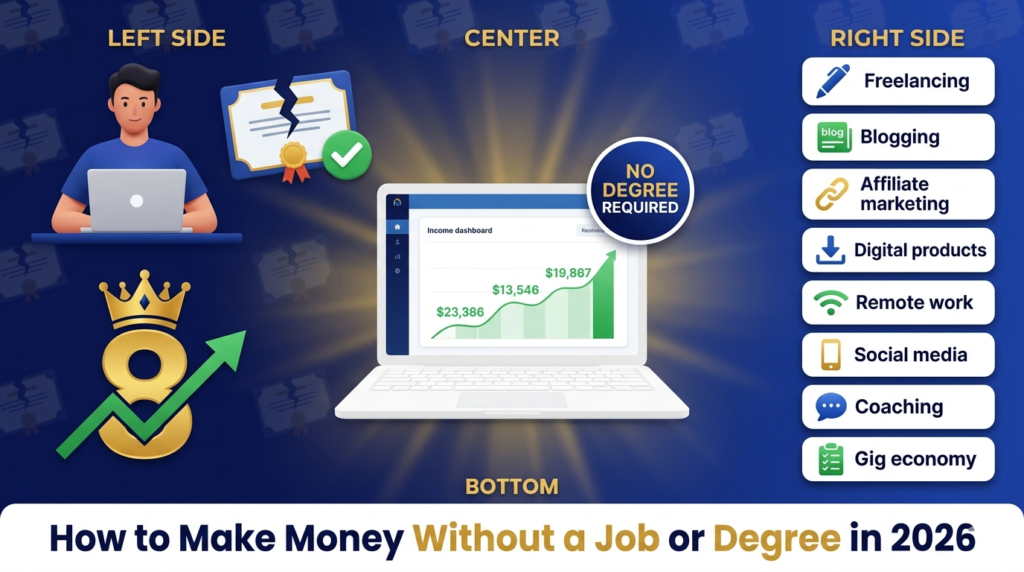
How to make money without a job or degree in 2026 is the question that exposes one of the most persistent and most damaging myths in modern income advice — the belief that a formal educational credential is a prerequisite for building genuine, sustainable income.
It is not. It never was. And in 2026, the gap between what a degree provides and what the market actually rewards has never been wider or more clearly documented.
The platforms, tools, and systems that generate real income in 2026 evaluate one thing: can you deliver a specific result that a specific buyer needs? Your educational background, your institutional affiliations, and your credential history are invisible to the algorithms, the clients, and the buyers who determine whether income arrives or does not.
This guide covers every legitimate method for making money without a job or degree in 2026, the specific advantages that people without degrees possess that credential-holders frequently do not, the honest challenges that the no-degree path presents, and the complete system for building from zero to consistent monthly income regardless of formal educational background.
2. How to Make Money Without a Job or Degree — The Honest Reality
How to make money without a job or degree in 2026 is genuinely more accessible than at any previous point in history — and the reason is structural, not motivational.
The economy that required degrees as gatekeeping mechanisms operated on information scarcity. Employers used degrees as proxies for capability because they had no better way to assess whether a candidate could perform a specific task. Degrees were certificates of demonstrated learning in the absence of any alternative demonstration system.
That information scarcity no longer exists. In 2026, a person without a degree can demonstrate copywriting capability through a portfolio of copy that converts. They can demonstrate data analysis capability through published work showing real findings. They can demonstrate teaching capability through a course that produces measurable student outcomes. The demonstration is the credential — and demonstration is available to everyone regardless of educational background.
3. Why Most People Without Degrees Fail to Build Income
The failure rate among people attempting to make money without a job or degree follows patterns that are specific to the no-degree context rather than universal to all income-building attempts.
Internalizing the credential myth is the first failure pattern. People without degrees frequently believe — because they have been told repeatedly — that their lack of formal education makes them less capable, less credible, and less deserving of professional rates. This belief produces underpricing, under-positioning, and under-confidence that limits income far more effectively than the absence of a degree itself.
Targeting credential-gated opportunities is the second failure pattern. Applying for positions that explicitly require degrees, pursuing platforms that use credential verification as a filter, and building strategies around income channels where formal education is a genuine prerequisite wastes enormous time on opportunities that are structurally inaccessible rather than identifying the far larger market of opportunities where credentials are irrelevant.
Overlooking the no-degree advantages is the third failure pattern. People without degrees frequently possess advantages that credential-holders do not — practical real-world experience, problem-solving developed outside academic frameworks, and the hunger and adaptability that comes from building capability without institutional support. These are genuine competitive advantages in many income contexts, and failing to recognize and leverage them is a significant strategic error.
4. Positive and Negative — What Making Money Without a Job or Degree Actually Looks Like
Real positive example: A twenty-four year old in the United States left college after one semester when he could not afford tuition. He spent six months learning copywriting through free online resources, built a portfolio of five spec pieces targeting e-commerce brands, and began cold outreach. By month eight he had four retainer clients paying a combined total of three thousand two hundred dollars per month — more than the starting salary of most graduates in his city with four-year degrees. By month eighteen his income had reached seven thousand dollars per month working from home with no degree, no institutional affiliation, and no credential beyond a portfolio of client results.
Real negative example: A twenty-two year old without a degree spent three months applying for remote marketing positions on LinkedIn that explicitly listed a bachelor’s degree in marketing or communications as a requirement. She received zero responses. Not because her skills were insufficient — she had been managing social media for local businesses for two years — but because her applications were filtered out by applicant tracking systems before a human ever reviewed them. The solution was not to get a degree. It was to stop applying for credential-gated positions and start pursuing the far larger market of clients who hire based on portfolio rather than credentials.
5. The Advantages of Making Money Without a Job or Degree in 2026
6. Advantage One — No Debt, No Obligation
The average student loan debt in the United States reached over thirty thousand dollars per graduate in recent years — a financial obligation that constrains career choices, geographic flexibility, and risk tolerance for years after graduation.
A person making money without a job or degree in 2026 carries none of this constraint. Every dollar earned is entirely theirs. Every career decision is made based on genuine preference and strategic calculation rather than the need to service institutional debt. The income flexibility available to someone without degree debt is genuinely superior to the income flexibility of a degree-holder managing significant monthly loan payments.
7. Advantage Two — Years of Compounding Head Start
A person who begins building income skills at eighteen without pursuing a four-year degree has four additional years of compounding professional development that a degree-pursuing peer does not.
Four years of freelancing experience means four years of client relationships, portfolio development, rate increases, and skill compounding. Four years of content creation means four years of audience building, search engine authority, and affiliate commission accumulation. The no-degree path, pursued seriously, does not produce inferior outcomes — it produces earlier outcomes.
8. The 8 Best Methods for Making Money Without a Job or Degree in 2026
9. Method One — Freelancing Without Credentials
Freelancing is the most immediately accessible method for making money without a job or degree in 2026 because the entire freelancing model is built around demonstrated capability rather than credentialed background.
No freelancing platform requires a degree. No client on Upwork, Fiverr, or Toptal asks to see a diploma before hiring. The hiring decision is made based on portfolio quality, proposal specificity, communication professionalism, and — most importantly — the client’s assessment of whether this specific person can deliver this specific result reliably.
Realistic income without a degree:
- Month 1-2: $0-$400 building portfolio and landing first clients
- Month 3-6: $400-$1,500 per month with consistent outreach
- Month 6-12: $1,500-$5,000 per month through specialization
- Year 2+: $5,000-$15,000+ per month through premium positioning
According to Upwork’s Resource Center, the skills in highest demand on the platform in 2026 — AI content editing, video production, web development, and digital marketing — have no formal education requirement and are learned most effectively through practice rather than academic study.
For the complete system for landing your first freelance client with zero experience and zero credentials, read: How to Land Your First Freelance Client With Zero Experience in 2026
10. Method Two — Content Creation and Blogging
Content creation rewards genuine expertise and authentic communication — neither of which requires formal education to develop or demonstrate.
A person without a degree who has spent three years learning digital marketing through practice, failure, and iteration possesses more current, more applicable, and more genuinely useful knowledge about digital marketing in 2026 than a recent graduate whose academic curriculum was designed five years ago and whose practical experience is limited to two internships.
Realistic income from content creation:
- Month 1-4: $0 building content foundation
- Month 5-8: $100-$600 per month from first rankings
- Month 9-18: $1,000-$6,000 per month as traffic compounds
- Year 2-3: $6,000-$40,000+ per month for established authority blogs
According to Backlinko’s Content Research, Google’s helpful content system evaluates content based on demonstrated expertise and genuine helpfulness — not the institutional credentials of the author. A person without a degree who writes from genuine experience consistently outranks a credentialed author writing from theoretical knowledge.
For the complete system for writing blog posts that rank consistently on Google page one, read: How to Write Blog Posts That Rank on Google Page 1 in 2026
11. Method Three — Affiliate Marketing
Affiliate marketing has no educational requirements, no credential verification, and no institutional gatekeeping of any kind. The income is determined entirely by the quality of content produced, the relevance of products recommended, and the trust built with a specific audience over time.
Realistic affiliate income without a degree:
- Month 1-3: $0 building content and traffic
- Month 4-6: $50-$400 per month from first rankings
- Month 6-12: $500-$4,000 per month as traffic compounds
- Year 2+: $5,000-$25,000+ per month for established sites
According to Authority Hacker, the most successful affiliate marketers in 2026 are not defined by educational background — they are defined by niche depth, content consistency, and the genuine trust their audience places in their recommendations.
For the complete framework for choosing affiliate products that actually convert, read: Affiliate Marketing for Beginners: How to Choose Products That Actually Convert in 2026
12. Method Four — Selling Digital Products
Digital products represent one of the purest meritocracies available in 2026 — the product either solves the buyer’s problem or it does not, and no credential attached to the creator changes that fundamental evaluation.
A person without a degree who has spent two years learning a specific skill through practice can create a genuinely useful guide, template, or course around that skill that outperforms the equivalent product created by a degree-holder with less practical experience.
Realistic digital product income:
- Month 1-2: $0 creating and validating
- Month 3-4: $100-$600 per month from early buyers
- Month 6-12: $1,000-$12,000 per month with growing audience
- Year 2+: $10,000-$60,000+ for established product libraries
According to Gumroad’s Creator Blog, the digital products generating the most consistent income in 2026 are created by practitioners — people who have done the thing they are teaching — regardless of whether that practice happened inside or outside of formal educational institutions.
For the complete system for creating and selling your first digital product, read: How to Create and Sell a Digital Product Online in 2026
13. Method Five — Remote Work Without Degree Requirements
Remote work opportunities without degree requirements have expanded dramatically in 2026 as companies have shifted their hiring criteria from credential-based filtering to skills-based assessment.
Customer support, virtual assistance, content moderation, data entry, social media management, and entry-level digital marketing roles are all consistently available as remote positions without degree requirements — and several companies have publicly committed to removing degree requirements from all positions below management level.
Realistic remote income without a degree:
- Week 1-4: Application and interview process
- Month 1-2: $800-$2,000 per month at entry level
- Month 6-12: $2,000-$5,000 per month with demonstrated performance
For the complete list of platforms and strategies for landing remote positions without degree requirements, read: Best Remote Job Platforms in 2026: Where to Apply and How to Get Hired Fast
14. Methods Six Through Eight
Social media monetization, coaching and consulting based on practical expertise, and gig economy work all represent income methods equally accessible without a degree as with one — and in several cases more accessible, because the no-degree practitioner has spent the years their credentialed peers spent in academic institutions developing the practical expertise that these methods reward directly.
For the complete guide covering every method available for making money without a job in 2026 including all eight methods in full detail, read: How to Make Money Without a Job in 2026: The Complete Beginner’s Guide
15. The Real Challenges of Making Money Without a Job or Degree
16. Challenge One — Credential Bias in Client Perception
Some clients — particularly those in traditional industries or corporate environments — carry credential bias that affects their initial assessment of freelancers and service providers without degrees. This bias rarely survives contact with a strong portfolio and professional communication, but it can create an initial barrier in specific market segments.
The honest fix: Target market segments where credential bias is minimal or nonexistent. Technology startups, small businesses, e-commerce brands, and direct-to-consumer companies consistently evaluate service providers based on portfolio quality rather than educational background. Building initial credibility in these segments creates the case study evidence that eventually opens doors in more credential-conscious markets if desired.
Real positive example: A web developer without a degree spent her first year exclusively targeting e-commerce startups and DTC brands — both known for skills-based hiring. By year two she had a portfolio of twelve completed projects with measurable revenue impact for each client. When she began targeting larger enterprise clients in year three, her portfolio of results was more persuasive than any degree certificate would have been.
17. Challenge Two — Self-Directed Learning Requires Discipline
The degree pathway provides external structure — a curriculum, deadlines, instructors, and an institutional framework that pushes progress even when motivation is absent. Making money without a job or degree requires replacing that external structure with internal discipline.
The honest fix: Create artificial external accountability structures. Public commitments — telling people what you are building and when you expect to achieve specific milestones — produce the social accountability that institutional frameworks provide automatically. Accountability partners, online communities, and published progress reports all substitute effectively for institutional structure.
18. Challenge Three — Income Proof Requires Time to Build
A degree is immediately legible as a credential — it communicates a minimum level of demonstrated capability in a format that requires no interpretation. A portfolio communicates equivalent or superior capability but requires the evaluator to spend time engaging with specific evidence rather than applying a universal shorthand.
The honest fix: Make portfolio evidence as immediately accessible and as easy to evaluate as possible. A one-page PDF with three specific case studies showing the problem, the approach, and the measurable result communicates capability faster than a forty-page portfolio that requires significant time investment to evaluate.
19. The 6-Month Roadmap for Making Money Without a Job or Degree
20. Month One — Skill Audit and Portfolio Foundation
Month one begins not with platform setup or outreach but with an honest audit of existing capabilities — practical skills developed through work experience, self-directed learning, personal projects, or any other non-academic context.
Every person without a degree who has been employed, self-employed, or engaged in any productive activity for more than six months has developed transferable skills. The audit process identifies which of these skills has commercial value, which is most learnable to a client-ready level within thirty days, and which represents a genuine competitive advantage rather than a commodity service.
21. Month Two — First Market Contact
Month two is where the theoretical skill identified in month one meets real market feedback for the first time. Send ten outreach messages. Publish two content pieces. List one digital product. Apply for five remote positions.
The feedback — responses and non-responses alike — reveals whether the positioning is resonating with the target market. Adjustments made in month two based on real market signal are more valuable than any amount of preparation done without market contact.
22. Month Three — First Income Signal
Month three produces the first concrete evidence that the chosen method works for a person without a degree in their specific circumstances.
For freelancers: a first client — possibly at a lower rate than desired. The rate is irrelevant. The evidence is what matters. A first client confirms that a person without a degree can sell their capability to a paying buyer. Everything after that is a matter of volume, specialization, and rate progression.
23. Month Four and Five — Positioning Refinement
By month four the market has provided enough feedback to identify which positioning is producing responses and which is not. Concentrate entirely on the positioning that is working.
People without degrees who reach month four with at least one client or one piece of ranking content have already outperformed the majority of people who attempt to make money without a job or degree — most of whom quit in months one or two when early results feel disproportionate to effort invested.
24. Month Six — The Proof Point
Month six produces the proof point that changes everything — not just the income, but the internal evidence that making money without a job or degree works specifically for this person in these circumstances.
That internal evidence is worth more than the income itself, because it is the foundation on which every subsequent income increase is built with genuine confidence rather than hope.
25. Common Mistakes When Making Money Without a Job or Degree
26. What Prevents Results From Arriving
Competing in credential-gated markets wastes enormous time and produces predictable rejection. The market for skills-based income is vastly larger than the market for credential-based income in 2026 — but it requires deliberately choosing platforms, clients, and channels where skills are evaluated on their merits.
Underpricing from credential insecurity is the mistake that most directly limits income for people without degrees. The correct pricing framework is based on the value delivered to the client — not on what feels appropriate given educational background. A client who receives ten thousand dollars of value from a copywriting project does not pay less because the copywriter lacks a degree.
Waiting for permission to claim expertise is the most damaging inaction pattern available to people making money without a job or degree. No institution will grant permission. No credential will arrive. The expertise is demonstrated through work, and the permission to claim it comes from the results that work produces.
27. Trusted External Resources
For understanding which skills are in highest demand among remote employers who have eliminated degree requirements from their hiring criteria, LinkedIn’s Jobs Trends Report provides current data on which roles and which industries are moving fastest toward skills-based hiring in 2026.
For self-directed learning resources that develop the specific skills most in demand for freelancing without formal education, Google’s free certification programs provide structured learning with recognized completion certificates in digital marketing, data analytics, and project management — all without degree prerequisites.
For understanding how Google evaluates content expertise without credential verification — foundational knowledge for anyone building blog or affiliate income, Google Search Central is the definitive primary source.
For digital product creation tools that require zero financial investment and are accessible without technical education, Canva’s Design Resources covers professional design production for complete beginners regardless of educational background.
For the broader context of every method available for making money without a job in 2026 beyond the no-degree specific approaches in this guide, read: How to Make Money Without a Job in 2026: The Complete Beginner’s Guide
28. Real Questions From People Without Degrees
Can you actually build a professional income without a degree in 2026?
Yes — and in many income categories, the no-degree practitioner with genuine practical experience builds professional income faster than the recent graduate whose practical experience is limited to academic projects and brief internships. The market evaluates results. Results are produced by practice. Practice is available to everyone regardless of educational background.
Which method is best for making money without a job or degree with no starting capital?
Freelancing requires the least starting capital of any method — a free profile on Upwork or Fiverr, a free portfolio hosted on a basic website, and the skill itself. The first hundred dollars of freelancing income can be earned before spending a single dollar on tools or platforms. No other method produces income this quickly from a zero-capital starting point.
How do you handle clients who ask about your educational background?
Most clients never ask. The portfolio and the proposal are what determine the hiring decision. For the rare client who raises educational background directly, the correct response is confident redirection to demonstrated results: “My background is practical rather than academic — here are three examples of the specific result you are looking for, delivered to clients with similar needs.” Results end the credential conversation more effectively than any defensive explanation.
What is the income ceiling for someone making money without a degree?
The income ceiling for skills-based income without a degree is functionally unlimited — identical to the income ceiling for credentialed practitioners in the same fields. The highest-earning copywriters, web developers, digital marketers, and content creators in 2026 include both degree-holders and people without degrees in roughly equal proportion. Income is determined by demonstrated capability and reputation — not by institutional credential.
How long does it take to reach a full-time income without a degree?
Reaching a full-time income equivalent — defined as matching the median starting salary for degree-holders in a comparable field — takes between twelve and twenty-four months for most people making money without a job or degree through skills-based methods. This timeline assumes consistent daily effort, genuine skill development, and progressive rate increases based on demonstrated results. People who treat the first year as serious professional development rather than casual experimentation consistently reach this milestone faster.
29. Final Words — The Degree Was Never the Point
How to make money without a job or degree in 2026 has one honest answer: the same way everyone else does — by developing a skill that solves a real problem, finding people who have that problem and are willing to pay for the solution, and delivering results that make them want to pay again and refer others.
The degree was never what produced the income. It was a proxy for capability in a system that had no better way to assess capability. That system no longer applies to the income methods in this guide — and the income available through these methods does not care whether the person pursuing it has a certificate from an institution on the wall.
What it cares about is the same thing it has always cared about: can you solve the problem? Can you deliver the result? Can you do it reliably enough that a client, a reader, or a buyer is willing to pay for it?
The answer to those questions is built through practice — available to everyone, gated by nothing, and compounding from the moment it begins.
Start today. The degree was never the point. The work always was.
For the complete picture of every online income method available in 2026, read: How to Make Money Online in 2026: The Complete Beginner’s Guide