
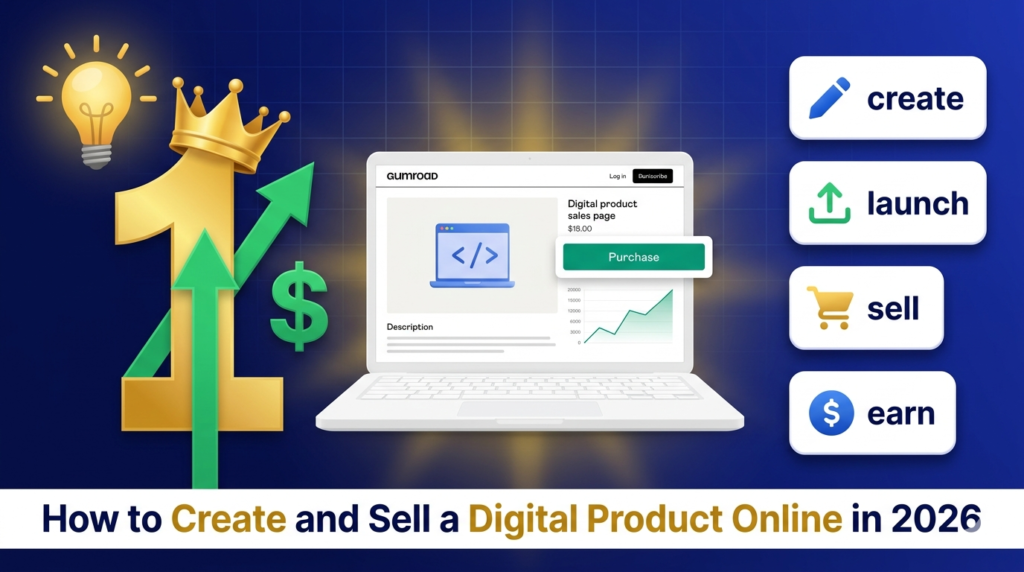
How to create and sell a digital product online is the most searched question among beginners who have discovered that physical products require inventory, shipping costs, and constant logistical headaches — while digital products require none of these things and can be sold unlimited times with zero additional cost per unit.
In 2026, the digital product economy has never been more accessible to complete beginners. Platforms exist that handle payment processing, file delivery, and customer management automatically. Tools exist that make professional product creation possible without design experience or technical skills. And markets exist that place your product in front of millions of buyers without paid advertising.
The difference between beginners who create digital products that sell and beginners who create digital products that nobody buys is not talent, design skill, or technical expertise. It is a specific product validation process that confirms genuine demand before a single hour is invested in creation — and this guide walks you through that process completely.
2. Why Most Beginners Fail to Create and Sell a Digital Product Online
Most beginners who attempt to create and sell a digital product online make the same foundational mistake before they write a single word or design a single slide: they build something they think people want rather than something people have already demonstrated they will pay for.
The result is predictable. A finished product, a launch day with real excitement, and then silence. No sales. No interest. No feedback. Just the quiet confirmation that the assumption was wrong.
This failure pattern is not a reflection of the product creator’s ability. It is the inevitable outcome of skipping the one step that separates digital products that sell consistently from digital products that collect digital dust — demand validation.
3. How to Create and Sell a Digital Product Online — The Positive Reality
The positive reality of creating and selling digital products online in 2026 is genuinely extraordinary compared to any previous business model available to individuals without capital.
Real positive example: A freelance writer created a single forty-seven page ebook covering the exact proposal writing system she used to go from zero to three thousand dollars per month on Upwork. She priced it at nineteen dollars on Gumroad, promoted it through three blog posts and her email list of three hundred subscribers, and sold sixty-two copies in the first thirty days — generating eleven hundred and seventy-eight dollars from content she wrote once in a single weekend.
The economics are unlike anything available in physical commerce. Create once, sell infinitely. No inventory costs, no shipping delays, no returns logistics, no production minimums. Every additional sale after the first is essentially pure margin.
4. How to Create and Sell a Digital Product Online — The Honest Challenges
The honest challenges of creating and selling digital products online are real and deserve acknowledgment before the excitement of the opportunity takes over completely.
Challenge one: Distribution is harder than creation. Most beginners discover that creating the product takes significantly less time than getting the product in front of people who want to buy it. Without an existing audience — an email list, a blog with traffic, a social media following — distribution requires deliberate strategy, not just publishing a product page and waiting.
Real negative example: A beginner spent three weeks creating a comprehensive spreadsheet template for freelance income tracking. The product was genuinely excellent — well-designed, practical, and solving a real problem. He listed it on Gumroad with no existing audience and no promotion strategy beyond sharing it once on his personal Facebook page. After sixty days, he had sold two copies — both to personal friends. The product was not the problem. Distribution was.
Challenge two: Pricing is counterintuitive. Beginners consistently underprice digital products out of fear that higher prices will prevent sales. The data consistently shows the opposite — underpriced digital products signal low quality to buyers and attract the most demanding, least satisfied customers. A well-positioned digital product priced at forty-seven dollars will typically outsell the same product priced at seven dollars because the higher price communicates that the content is worth taking seriously.
Challenge three: The first product rarely succeeds perfectly. The first digital product most creators launch is a learning exercise as much as a commercial venture. The feedback — what buyers love, what they find confusing, what they wish was included — is what makes the second product genuinely excellent and the third product a reliable income generator.
5. Step One — Finding a Digital Product Idea That Will Actually Sell
6. How to Create and Sell a Digital Product Online — Validating Demand Before Building
The demand validation process that prevents the most common and most costly beginner mistake is simple and requires no budget, no audience, and no technical tools — only honest research conducted before any creation work begins.
Research step one: Open Amazon and search for books in your topic area. Sort by bestseller rank. The books with the highest sales ranks and the most reviews represent topics that people are actively spending money to learn about. The specific complaints in the one and two star reviews of bestselling books represent the gaps those books fail to fill — and gaps represent product opportunities.
Research step two: Open Udemy and search for courses in your topic. Filter by bestselling. Note the course titles, the number of enrolled students, and the specific learning outcomes promised in each course description. A course with fifty thousand enrolled students at nineteen dollars has generated nearly one million dollars in revenue — confirming that the topic has genuine commercial demand.
Research step three: Open Etsy and search for digital downloads in your category. The products with the most sales and the most reviews reveal what format — templates, guides, worksheets, planners — buyers in your niche prefer to purchase.
Research step four: Open Reddit and search for communities related to your topic. Read the most upvoted posts from the past year. The questions that appear repeatedly — the problems people describe in detail, the things they wish existed, the resources they ask for — represent validated demand waiting for a product solution.
According to Gumroad’s Creator Data, the digital products that generate the most consistent income are not the most comprehensive or the most beautifully designed — they are the ones that solve the most specific, most urgent problem for the most clearly defined buyer.
7. The Six Most Profitable Digital Product Types in 2026
Understanding which digital product formats produce the strongest combination of creation accessibility and market demand helps beginners choose the right vehicle for their first product rather than discovering through expensive trial and error that some formats work significantly better than others for specific audiences.
Ebooks and guides remain the most accessible entry point for creating and selling digital products online. A well-structured, genuinely useful guide of thirty to eighty pages addressing a specific problem can be created in a single focused weekend using free tools and priced between fifteen and forty-seven dollars. The format is universally understood by buyers, requires no technical delivery infrastructure beyond a PDF file, and can be updated and repriced as the creator’s understanding of their market deepens.
Templates and done-for-you resources are the fastest-growing digital product category in 2026 because they deliver the outcome the buyer wants without requiring them to learn anything new. A Notion template for freelance project management, a Canva template pack for social media content creation, a spreadsheet for tracking affiliate marketing income — all of these deliver immediate, tangible value that buyers can use the moment the download completes.
Online courses and video training represent the highest-ticket digital product format available to individual creators. A structured video course teaching a specific skill can command prices from ninety-seven dollars to nine hundred and ninety-seven dollars depending on the depth of the content and the specificity of the promised outcome. The creation barrier is higher than other formats, but the income ceiling is correspondingly higher.
Notion and Canva templates have emerged as one of the highest-demand digital product categories on platforms like Etsy, Gumroad, and Creative Market. A well-designed Notion workspace template addressing a specific workflow — content creation planning, freelance client management, personal finance tracking — can be created in a few hours and sold indefinitely at prices ranging from seven to thirty-seven dollars.
Swipe files and resource libraries compile the best examples, scripts, frameworks, or tools in a specific niche into a single downloadable resource that saves the buyer significant research time. A swipe file of one hundred high-converting email subject lines for e-commerce brands, a library of proven freelance proposal templates, or a collection of the best SEO keyword research frameworks — all represent genuine value that buyers are willing to pay for because the alternative is spending dozens of hours compiling the same information themselves.
Audio products and guided recordings including meditation guides, language learning audio content, and educational podcast-style courses represent an underserved format with strong demand and low competition relative to written and video content.
For the complete picture of how digital products fit within a broader online income strategy, read: How to Make Money Online in 2026: The Complete Beginner’s Guide
8. How to Create and Sell a Digital Product Online — Creation Framework
9. How to Create and Sell a Digital Product Online — The Creation Framework
The creation framework that produces digital products buyers love and recommend follows a specific structure that most beginners discover only after their first unsuccessful launch.
Start with the outcome, not the content. Before writing a single page or recording a single slide, write one sentence that completes this prompt: “After purchasing and using this product, the buyer will be able to _.” The more specific and measurable this outcome, the more clearly the product can be structured to deliver it, and the more compellingly the product can be marketed to the buyers who want that outcome.
Build the simplest version first. The most common creation mistake is scope expansion — adding more chapters, more modules, more templates, more bonuses until the product has doubled in size and tripled in creation time without proportionally increasing the value delivered to buyers. The minimum viable product that reliably delivers the promised outcome is the correct first version. Expansion comes after buyer feedback confirms what is genuinely missing.
Use free tools for professional results. Canva produces professional ebook layouts, template designs, and presentation slides at zero cost. Google Docs handles written content creation and exports to professional PDF format. Loom records high-quality video content without expensive equipment. OBS Studio records and produces video courses free of charge. The belief that professional digital product creation requires expensive software is one of the most persistent and most costly myths beginners accept without questioning.
According to Teachable’s Creator Report, the most successful digital product creators spend forty percent of their total product development time on research and validation and only sixty percent on creation — confirming that knowing what to create matters more than the speed or quality of the creation itself.
10. How to Create and Sell a Digital Product — Tools That Cost Nothing
The complete toolkit for creating professional digital products in 2026 requires zero financial investment and produces results indistinguishable from products created with expensive paid tools.
Canva at canva.com handles ebook design, template creation, workbook layouts, social media graphics, and presentation slides with a free tier that provides everything a beginner needs. The professional templates library eliminates the need for design expertise entirely.
Google Docs and Google Slides handle written content creation and presentation-style course content with automatic cloud saving, easy PDF export, and seamless collaboration if the product is being created with a partner.
Loom at loom.com records high-quality screen capture and webcam video content free of charge — making it the ideal tool for creating video course content, tutorial walkthroughs, and training material without investing in video production equipment.
Notion at notion.so serves double duty as both a creation tool for organizing and structuring content and as a product format itself — Notion templates are one of the most in-demand digital product categories available in 2026.
11. How to Create and Sell a Digital Product Online — Sales Infrastructure
12. How to Create and Sell a Digital Product Online — Choosing Your Platform
The platform you choose to sell your digital product determines how buyers find it, how they pay for it, how they receive it, and how much of each sale you keep. Three platforms stand out as the best options for beginners in 2026.
Gumroad at gumroad.com is the most beginner-friendly digital product sales platform available. Setup takes less than thirty minutes. Payment processing, file delivery, receipt generation, and basic analytics are all handled automatically. The free tier charges a ten percent transaction fee per sale — a reasonable cost that eliminates all upfront platform investment. As monthly sales increase, the transaction fee decreases.
Lemon Squeezy has emerged as the strongest alternative to Gumroad in 2026, offering similar functionality with more flexible pricing options and stronger international payment support. For creators targeting global audiences, Lemon Squeezy’s multi-currency support and VAT handling make it operationally simpler than managing international sales independently.
Etsy provides built-in marketplace traffic for digital product categories that perform well on the platform — templates, printables, planners, and design assets. Unlike Gumroad and Lemon Squeezy where traffic must be generated externally, Etsy buyers are actively searching the platform for digital products. The trade-off is higher fees and less control over the customer relationship.
For the complete guide on affiliate marketing strategies that complement digital product income, read: Affiliate Marketing for Beginners: How to Choose Products That Actually Convert in 2026
13. How to Create and Sell a Digital Product Online — Pricing for Maximum Revenue
Pricing a digital product correctly is one of the most consequential decisions in the entire creation and selling process — and the decision that most beginners get catastrophically wrong in the direction of underpricing.
The psychological reality of digital product pricing is counterintuitive but well-documented. Buyers use price as a proxy for quality when they cannot directly evaluate the product before purchasing. A digital product priced at four dollars signals that even its creator does not believe it is worth much. The same product priced at forty-seven dollars signals confidence in the value delivered — and that confidence is contagious.
The pricing framework that produces maximum revenue for most digital products follows three tiers based on the depth of transformation delivered.
Quick-win products — checklists, templates, swipe files, short guides — priced between seven and twenty-seven dollars. These are impulse purchases that buyers make without significant deliberation. High volume, lower individual transaction value.
Comprehensive guides and workbooks priced between twenty-seven and sixty-seven dollars. These require more consideration from buyers but represent genuine investment in a significant outcome. This price range produces the strongest combination of sales volume and per-transaction revenue for most beginner digital product creators.
Course and training programs priced between ninety-seven and four hundred and ninety-seven dollars. These require the most buyer deliberation and the strongest marketing, but deliver the highest revenue per transaction and attract the most committed buyers who are most likely to achieve the promised outcome and recommend the product to others.
14. Step Four — Marketing Your Digital Product
15. How to Create and Sell a Digital Product Online — Driving Your First Sales
The distribution challenge that causes most digital products to fail commercially is not a market problem — it is a promotion problem. The product exists. The buyers exist. The gap is a visible, discoverable path connecting the two.
For a blogger with a growing content library, the most reliable first-sales channel is content marketing — writing blog posts that address the exact problem the product solves, demonstrating expertise through the content, and presenting the product as the natural next step for readers who want to go deeper than a free article can take them.
Real example: A blogger writing about freelancing for beginners created a template pack of ten proven proposal templates used to land clients in five different niches. She published a detailed blog post titled “Why Your Freelance Proposals Are Being Ignored (And the Fix)” — the post addressed the problem completely and honestly, then presented the template pack as the implementation shortcut for readers who wanted proven starting points rather than creating their proposal structure from scratch. The post drove forty-three template pack sales in its first sixty days at twenty-seven dollars each — eleven hundred and sixty-one dollars from a single piece of content connected to a single product.
For the complete content strategy that drives organic traffic to your digital products, read: How to Write Blog Posts That Rank on Google Page 1 in 2026
16. How to Create and Sell a Digital Product — Email Marketing as a Sales Engine
Email marketing is the highest-converting sales channel available for digital products — consistently outperforming social media, organic search, and paid advertising in terms of revenue generated per audience member reached.
The structural reason is simple. A social media follower sees your post if the algorithm chooses to show it. A search visitor finds your content if Google ranks it. An email subscriber receives your message directly, has explicitly opted in to hear from you, and has already demonstrated a level of engagement with your content that passive followers and cold search visitors have not.
Building an email list of five hundred engaged subscribers produces more digital product revenue than having ten thousand social media followers who passively consume content without opting in to a deeper relationship.
The email list building process for digital product creators follows a proven sequence. Create a free resource — a shorter version of your paid product, a related checklist, a complementary template — that provides genuine standalone value. Offer that resource to blog readers in exchange for their email address. Send a welcome sequence of three to five emails that deliver the promised resource, demonstrate additional expertise, and introduce the paid product as the natural next step for readers who want complete implementation rather than a starting point.
According to Mailchimp’s Email Marketing Statistics, email marketing generates an average return of thirty-six dollars for every one dollar invested — making it the highest-ROI marketing channel available to digital product creators at any stage of their business.
17. How to Create and Sell a Digital Product Online — Realistic Timeline
18. Month by Month — What Creating and Selling Digital Products Actually Produces
Month one is entirely invested in research, validation, and creation. No income yet — and no income should be expected. This month is the foundation investment that determines whether the product has commercial potential before launch rather than after.
Month two is the launch month. First sales arrive — typically from warm audiences like blog readers, social media followers, or personal networks. For most beginners launching their first product without an established audience, month two produces between zero and five sales. This is not failure — it is the beginning of learning what marketing approaches work for this specific product and this specific audience.
Month three and four is the iteration phase. Feedback from early buyers reveals what the product delivers well and what it misses. The product is updated. The marketing is refined. Sales become more consistent as the product-market fit tightens.
Month five and six is where consistent promotion through blog content and email marketing begins producing reliable monthly revenue. Fifty to two hundred dollars per month is a realistic range for a beginner with a small but engaged audience and a well-positioned product.
Month seven through twelve is the compounding phase. Additional products are created. Blog content driving traffic to the first product accumulates. Email list grows. Monthly digital product income reaches three hundred to one thousand dollars for creators who have maintained consistent content and promotion.
18. Common Mistakes When Creating and Selling Digital Products Online
19. What Prevents Digital Products From Selling
Creating without validating remains the single most common and most costly mistake. No validation process in the world takes longer than the time wasted creating a product nobody buys.
Underpricing from fear consistently reduces both revenue and perceived quality simultaneously. Price based on the value of the outcome delivered — not on what feels safe or what the creator personally would pay.
Launching without a promotion plan treats the product listing as the marketing strategy. A product page with no traffic produces no sales regardless of product quality. Every product launch requires a specific, pre-planned promotion strategy executed before, during, and after launch day.
Creating one product and waiting instead of building a product library reduces the income ceiling significantly. Buyers who purchase one product and find value in it are the most likely buyers for a second, third, and fourth product from the same creator. A library of three to five complementary products produces dramatically more revenue than a single product at any price point.
Ignoring buyer feedback prevents the product improvements that convert satisfied buyers into vocal advocates. Every piece of buyer feedback — positive and critical — is commercial intelligence that makes the next product better and the existing product more valuable.
20. Trusted External Resources
For the most practical, experience-based guidance on creating and launching digital products that sell from creators who have built multiple successful digital product businesses, Pat Flynn’s Smart Passive Income provides case studies and frameworks unavailable in most product creation guides.
For understanding how to price digital products optimally based on market data and buyer psychology research, Gumroad’s Creator Blog publishes real creator income data and pricing insights drawn from millions of digital product transactions on the platform.
For the complete toolkit of free creation tools that produce professional digital products without financial investment, Canva’s Design School provides tutorials covering every format a digital product creator needs — ebooks, templates, presentations, and workbooks.
For building the email list that transforms digital product sales from occasional to consistent, Mailchimp’s Resources covers every aspect of email marketing strategy relevant to digital product creators at the beginner level.
For understanding how to drive organic search traffic to your digital product sales pages through strategic blog content, Backlinko’s Content Marketing Guide provides the most data-driven framework for content-driven product promotion available.
For the broader online income context that makes digital products most powerful when combined with affiliate marketing, freelancing, and blogging, return to: How to Make Money Online in 2026: The Complete Beginner’s Guide
21. Real Questions From Digital Product Beginners
How long does it take to create a digital product that actually sells?
Creating a digital product that sells requires two separate time investments that most guides conflate. The research and validation phase — confirming genuine demand before building — takes three to seven days of honest research using the methods described in this guide. The creation phase for a well-scoped first product — an ebook, a template pack, or a short course — takes one to two focused weekends for most beginners. The total creation investment is typically ten to twenty hours. What takes significantly longer is building the audience and content infrastructure that drives consistent traffic to the product — a process that unfolds over months of consistent blogging and email list building rather than days of product creation.
Do you need a large audience to sell digital products online?
No — but you need some audience, or a platform with built-in traffic. A blog with three hundred monthly readers, an email list of one hundred engaged subscribers, or an Etsy shop in a category with active buyer traffic are all sufficient starting points for first digital product sales. What does not work is creating a product, listing it on a platform with no traffic, and waiting for sales to arrive without any promotion. The product and the audience must be built simultaneously — not sequentially.
What is the best platform for selling digital products as a complete beginner?
Gumroad is the strongest starting point for most beginners because it eliminates every technical barrier to getting a product live and available for purchase. Setup is genuinely achievable in under thirty minutes with zero technical knowledge. For beginners whose product format — templates, printables, design assets — aligns with Etsy’s marketplace traffic, Etsy provides the additional advantage of built-in buyer discovery without requiring the creator to generate all traffic independently.
How do you handle refunds and unhappy buyers?
Handle every refund request immediately and without argument. The reputation cost of a public dispute over a digital product refund vastly exceeds the revenue cost of the refund itself. A creator who processes refunds quickly and professionally loses a small amount of revenue and gains a reputation for integrity — which is commercially more valuable than any individual sale. On Gumroad, refund processing is straightforward and takes less than two minutes.
Can you sell digital products without a website?
Yes — Gumroad, Etsy, and Lemon Squeezy all provide standalone product pages that function without a creator website. However, a blog or content website accelerates digital product income significantly by providing a traffic generation engine that compounds over time. Selling without a website is possible for a first product. Building a sustainable digital product business without content infrastructure is significantly harder and slower than the alternative.
22. Final Words — Creating and Selling Your First Digital Product Starts With One Right Idea
How to create and sell a digital product online is not a question that requires months of preparation, expensive tools, or an existing audience to answer with action. It requires a validated idea, a focused creation effort, a simple sales infrastructure, and a promotion strategy connected to genuine content.
The beginner who validates demand first, creates the minimum viable product that delivers the promised outcome, prices it based on value rather than fear, and promotes it through consistent content creation will generate their first digital product sale faster than any beginner who invests months perfecting a product nobody asked for.
One right idea validated correctly. One product built to deliver one specific outcome. One platform set up to handle payment and delivery. One piece of content connecting the right reader to the right solution.
That is the entire system. And every element of it is available to you today, at zero cost, starting right now.
For landing the freelancing clients that fund your digital product creation time, read: How to Land Your First Freelance Client With Zero Experience in 2026